Trees are among the most valuable natural resources on Earth. They clean polluted air, absorb carbon dioxide, regulate temperature, protect water supplies, prevent soil erosion and provide habitats for wildlife. Forests also support the food, income, medicine and cultural identity of millions of people.
Despite these benefits, forests continue to be cleared for agriculture, cattle ranching, mining, roads, housing, timber and fuel. Poverty, weak governance, illegal logging and rising global demand for commodities make the problem particularly serious in parts of Africa, Latin America and Southeast Asia.
According to the UN Food and Agriculture Organization’s Global Forest Resources Assessment 2025, forests cover approximately 4.14 billion hectares—about one-third of the world’s land area. Although the long-term rate of deforestation has slowed, forest destruction remains a major environmental challenge. Furthermore, climate change is making surviving forests increasingly vulnerable to drought, fires, storms, pests and disease.
Trees Clean the Air
One of the most important functions of trees is their ability to improve air quality. Through photosynthesis, trees absorb carbon dioxide and release oxygen. Carbon dioxide is a naturally occurring gas, but excessive concentrations caused by fossil-fuel use, industrial activity and deforestation contribute to global warming.
Leaves and bark also capture airborne pollutants and fine particles. Trees can help reduce exposure to pollutants produced by traffic, construction, factories and the burning of waste. This is especially important in large cities, where poor air quality contributes to respiratory and cardiovascular illnesses.
However, trees should be considered part of a broader clean-air strategy, not a replacement for reducing emissions. A city cannot plant its way out of uncontrolled industrial pollution or excessively dirty transport. It needs cleaner fuels, efficient public transport and strict emissions standards alongside an expanded urban tree canopy.
Trees Help Control Climate Change
Forests act as natural carbon reservoirs. As trees grow, they take carbon dioxide from the atmosphere and store carbon in their trunks, branches, roots and surrounding soil.
When forests are cut and burned, much of this carbon returns to the atmosphere. Deforestation therefore causes two forms of damage: it releases stored greenhouse gases and removes trees that could absorb carbon in the future.
Forests also regulate temperature and moisture. Trees cool the environment through shade and transpiration—the process through which plants release water vapour. Urban areas with insufficient vegetation often experience the “heat-island effect,” in which concrete and asphalt absorb and retain heat. Planting suitable trees along roads, in parks and around buildings can make cities more comfortable while reducing demand for air conditioning.
At a regional level, large forests recycle water into the atmosphere and influence rainfall. Their destruction can change rainfall patterns, increase drought risk and damage agriculture far beyond the area where trees were removed.
Protection of Water, Soil and Agriculture
Healthy forests function like natural water-management systems. Tree roots allow water to enter the soil, while vegetation slows the movement of rainwater across the ground. This helps recharge groundwater and reduces rapid runoff.
Removing trees from hillsides can expose soil to heavy rain and strong winds. Fertile topsoil may then be washed away, rivers can become filled with sediment, and the danger of flash floods and landslides can increase. The loss of soil fertility eventually reduces agricultural productivity, creating pressure to clear even more land.
Trees are also important for farms. Agroforestry—the deliberate integration of trees with crops or livestock—can improve soil health, provide shade, reduce wind damage and give farmers additional products such as fruit, fodder, timber, nuts and medicine. Protecting trees should therefore not be viewed as being opposed to food production. Properly planned agriculture and tree conservation can support each other.
Forests Are Homes for Biodiversity
Forests contain complex communities of animals, plants, fungi and microorganisms. Some species can survive only in a particular forest habitat. When forests are cleared or divided by roads and development, wildlife populations become isolated and their access to food, water and breeding areas is reduced.
Biodiversity is not merely an environmental luxury. It supports pollination, natural pest control, soil formation, medicine and the resilience of food systems. According to the United Nations, more than one billion people depend on forests for their livelihoods.
Planting new trees is valuable, but a young plantation cannot immediately replace an ancient natural forest. Mature forests contain complicated relationships among species that may have developed over hundreds or thousands of years. The first priority should therefore be to protect remaining natural forests, followed by restoring degraded land with diverse native species.
Why Are Trees Being Cut Down?
Expansion of agriculture
Agriculture is the largest global driver of deforestation. Forests are cleared to create cattle pasture and to grow commodities such as soy, palm oil, cocoa, rubber and coffee.
An analysis by the World Resources Institute found that cattle pasture occupied approximately 45.1 million hectares of land deforested between 2001 and 2015—more than any of the other major commodities examined. Oil-palm cultivation was another important driver, especially in Indonesia and Malaysia.
In some regions, commercial companies carry out large-scale clearing. Elsewhere, poor families clear small areas because they lack access to productive land, modern farming methods, electricity and alternative employment. These situations require different policy responses.
Timber, firewood and charcoal
Trees are cut legally and illegally for construction materials, furniture, paper and other products. Timber harvesting does not always constitute permanent deforestation if forests are responsibly managed and allowed to regenerate. However, logging becomes highly destructive when extraction is excessive, illegal or followed by conversion of the land to farms, mines or settlements.
Firewood and charcoal remain essential sources of household energy in many developing countries. In the Democratic Republic of the Congo, for example, wood harvesting for fuel and charcoal is an important cause of forest degradation. Simply banning firewood without providing affordable alternatives could punish poor households. Governments must expand access to clean cooking fuels, electricity and efficient stoves.
Mining, roads and urban development
Mining operations remove vegetation directly and often cause wider damage by bringing roads, workers and settlements into previously inaccessible forests. Roads can open vast areas to logging, land grabbing and agricultural expansion.
Cities also need land for housing and infrastructure. Poorly planned development frequently destroys woodland, wetlands and agricultural land. Urban planning should identify environmentally sensitive areas before construction begins and require developers to retain or replace trees.
Poverty and insecure land rights
Deforestation is often related to poverty, inequality and insecure ownership. People who do not legally control the land they use may have little incentive to protect trees for the future. Powerful businesses or land grabbers may exploit unclear ownership to seize forest areas.
Indigenous Peoples and local communities have protected many important forests for generations. Recognising their customary land rights and involving them in decisions can be more effective than declaring protected areas without community participation.
Weak governance and corruption
Good legislation achieves little when authorities lack funding, trained personnel or political independence. Illegal operators may bribe officials, falsify permits or move timber through complicated supply chains. In areas affected by conflict, government agencies may be unable to monitor forests at all.
Consumers in wealthy countries also contribute indirectly when they buy beef, timber, palm oil, cocoa, gold or other products associated with forest clearance. Deforestation is therefore not solely a problem of countries where forests are located; it is connected to global markets.
Climate change and wildfires
Not every episode of tree-cover loss is permanent deforestation. Fires may temporarily remove trees in ecosystems capable of regeneration. Nevertheless, increasingly severe fires can cause lasting degradation and make later conversion more likely.
The World Resources Institute reported that fires accounted for 42 percent of the world’s 25.5 million hectares of tree-cover loss in 2025. Climate change is intensifying heat and drought, while people deliberately set some fires to clear land. Fire prevention must consequently address both climatic conditions and human behaviour.
How Can Trees and Forests Be Saved?
Strong Laws and Effective Enforcement
Countries need clear legislation governing land use, logging, mining, agriculture and infrastructure. Important measures include:
- Making illegal forest clearance a serious and enforceable offence.
- Requiring environmental-impact assessments before large projects begin.
- Establishing protected forests and ecological corridors.
- Preventing companies from acquiring land through fraudulent or corrupt practices.
- Requiring timber and agricultural products to be traceable to their source.
- Holding companies responsible for environmental damage in their supply chains.
- Protecting environmental activists, forest rangers and whistle-blowers.
- Requiring replacement planting where tree removal is genuinely unavoidable.
Penalties must be greater than the profits generated by illegal activity. A small fine may simply become a business expense. Authorities should be able to suspend permits, seize illegally obtained assets and require offenders to restore damaged areas.
Satellite monitoring can identify newly cleared land, but images alone cannot arrest an offender. Governments also need investigators, prosecutors, courts and properly equipped forest departments.
Brazil demonstrates that coordinated government action can produce results. According to the World Resources Institute, Brazil recorded its lowest level of non-fire tropical primary-forest loss in the monitoring series in 2025, with a 41 percent reduction from 2024. The decline was associated with stronger environmental policies, monitoring and enforcement. This progress also illustrates that deforestation is influenced by political choices and is not unavoidable.
Public Awareness and Environmental Education
Legislation is essential, but laws cannot succeed without public understanding and participation. Awareness campaigns can explain how tree loss affects heat, water, flooding, farming, health and household income.
Effective campaigns should go beyond occasional slogans or ceremonial tree-planting photographs. Schools can establish environmental clubs, teach children to care for local trees and involve students in monitoring planted saplings. Television, radio, newspapers, websites and social media can expose illegal clearing and explain responsible consumer choices.
Religious leaders, teachers, celebrities, farmers’ organisations and community elders can make environmental messages locally relevant. Campaigns should also publish practical information: which species should be planted, where they should be planted and who will water and protect them.
Community Forestry and Local Incentives
Communities are more likely to protect forests when they receive fair benefits from conservation. Governments can support community-managed forests, ecotourism, sustainable harvesting, beekeeping, agroforestry and payments for ecosystem services.
Conservation programmes must provide alternatives for people whose survival depends on clearing trees. These may include clean cooking energy, agricultural training, secure land tenure, small-business finance and payment for restoration work.
Tree protection will remain difficult if cutting a forest provides immediate income while conserving it provides no visible economic reward.
Responsible Farming and Business
Increasing productivity on existing farmland can reduce pressure to clear new areas, provided that higher profits do not encourage further expansion. Governments should direct agricultural incentives toward degraded or previously cleared land rather than natural forests.
Companies should adopt credible zero-deforestation supply chains and publish information about where their raw materials come from. Certification schemes can help, but they need independent audits, transparent standards and consequences for violations.
Consumers can contribute by reducing waste, choosing recycled or responsibly certified wood and paper, and supporting businesses that can demonstrate deforestation-free sourcing.
Restoration and Proper Tree Planting
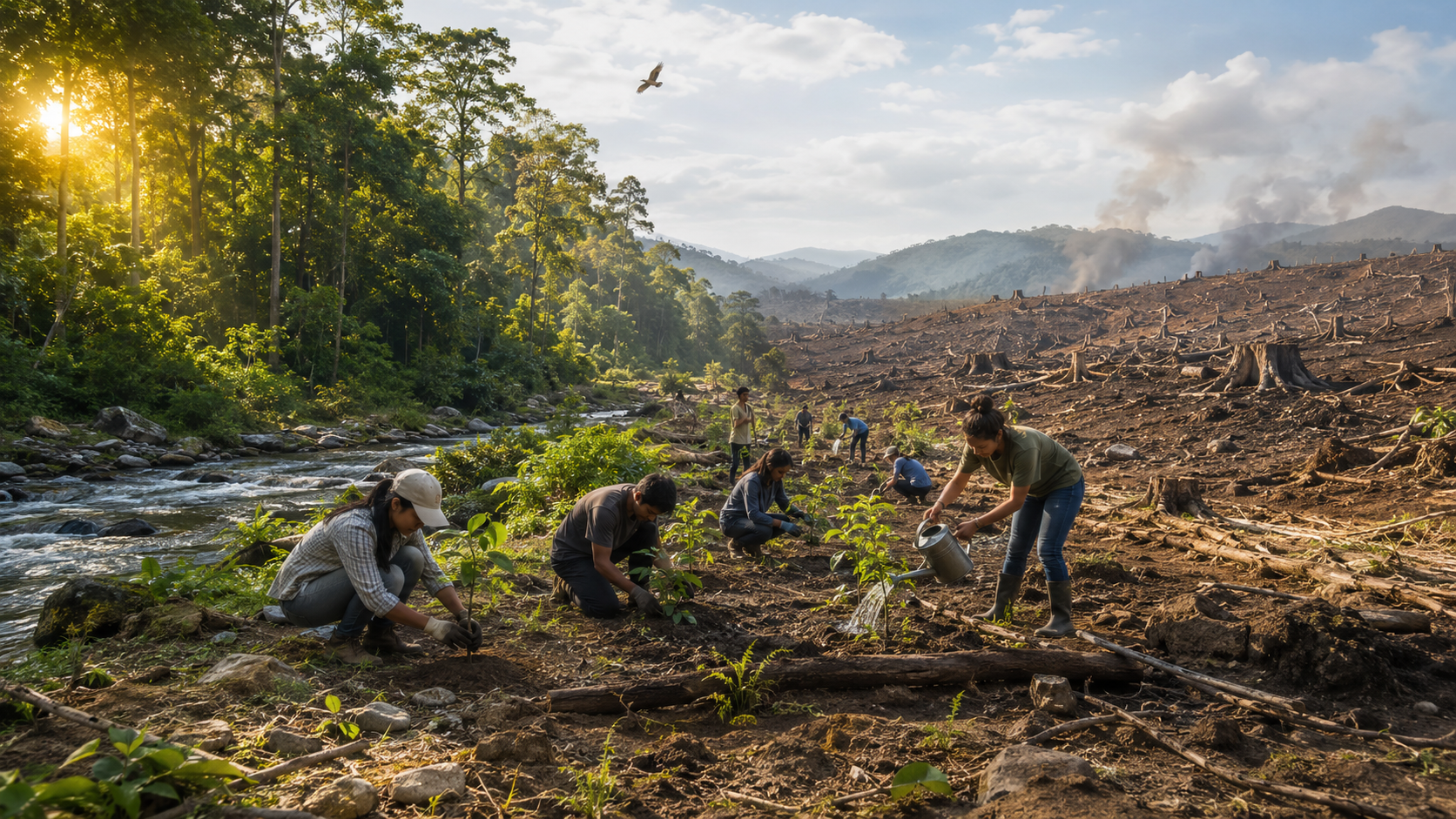
Tree-planting campaigns are helpful only when they are scientifically planned. Success should be measured by how many trees survive after several years—not by how many seedlings are distributed in a single day.
Native species are generally preferable because they are adapted to local conditions and support local wildlife. Planting should be followed by watering, protection from grazing, replacement of dead saplings and long-term monitoring. Diverse forests are usually more resilient than single-species plantations.
Restoration should not be used to justify destroying an existing natural forest. Protecting a mature ecosystem is normally more effective and less expensive than attempting to recreate it later.
Legislation or Awareness Campaigns: Which Is More Important?
The correct answer is that both are necessary.
Legislation establishes rules, responsibilities and penalties. Awareness creates public support, encourages voluntary action and helps communities report violations. Without enforcement, an awareness campaign may become symbolic. Without public participation, laws may be ignored, resisted or selectively applied.
A successful forest strategy connects the two. Governments should introduce clear laws, transparent monitoring and meaningful punishment while simultaneously educating citizens, supporting communities and providing alternatives to destructive activities.
Conclusion
Trees are not decorations that can be removed without consequence. They are part of the environmental infrastructure that supplies clean air, regulates climate, protects water and soil, supports wildlife and sustains human livelihoods.
Deforestation occurs because the short-term financial rewards of clearing land are often given greater importance than the long-term value of a living forest. Agriculture, cattle ranching, timber, mining, roads, energy poverty, corruption and climate-driven fires all contribute, although the mixture differs from one country to another.
Forests can still be saved. Strong laws, honest enforcement, community land rights, responsible supply chains, sustainable farming, clean energy, public education and properly managed restoration have already produced improvements in some countries. The central lesson is simple: tree protection must become part of economic planning, public health, education and national development—not an activity reserved for environmental departments or annual planting ceremonies.
References
- Food and Agriculture Organization of the United Nations. Global Forest Resources Assessment 2025.
- FAO. The State of the World’s Forests 2024.
- United Nations Environment Programme. Why Do Forests Matter?.
- United Nations. Biodiversity—Our Strongest Natural Defence Against Climate Change.
- World Resources Institute. Tropical Rainforest Loss Slowed in 2025, but Fire Is a Growing Threat.
- World Resources Institute. Deforestation Linked to Agriculture.
- World Wildlife Fund. Deforestation and Forest Degradation.
- UNEP World Conservation Monitoring Centre. Exploring the Vital Role of Our Forests.
- Our World in Data. Deforestation and Forest Loss.
- World Bank. Causes of Deforestation of the Brazilian Amazon.