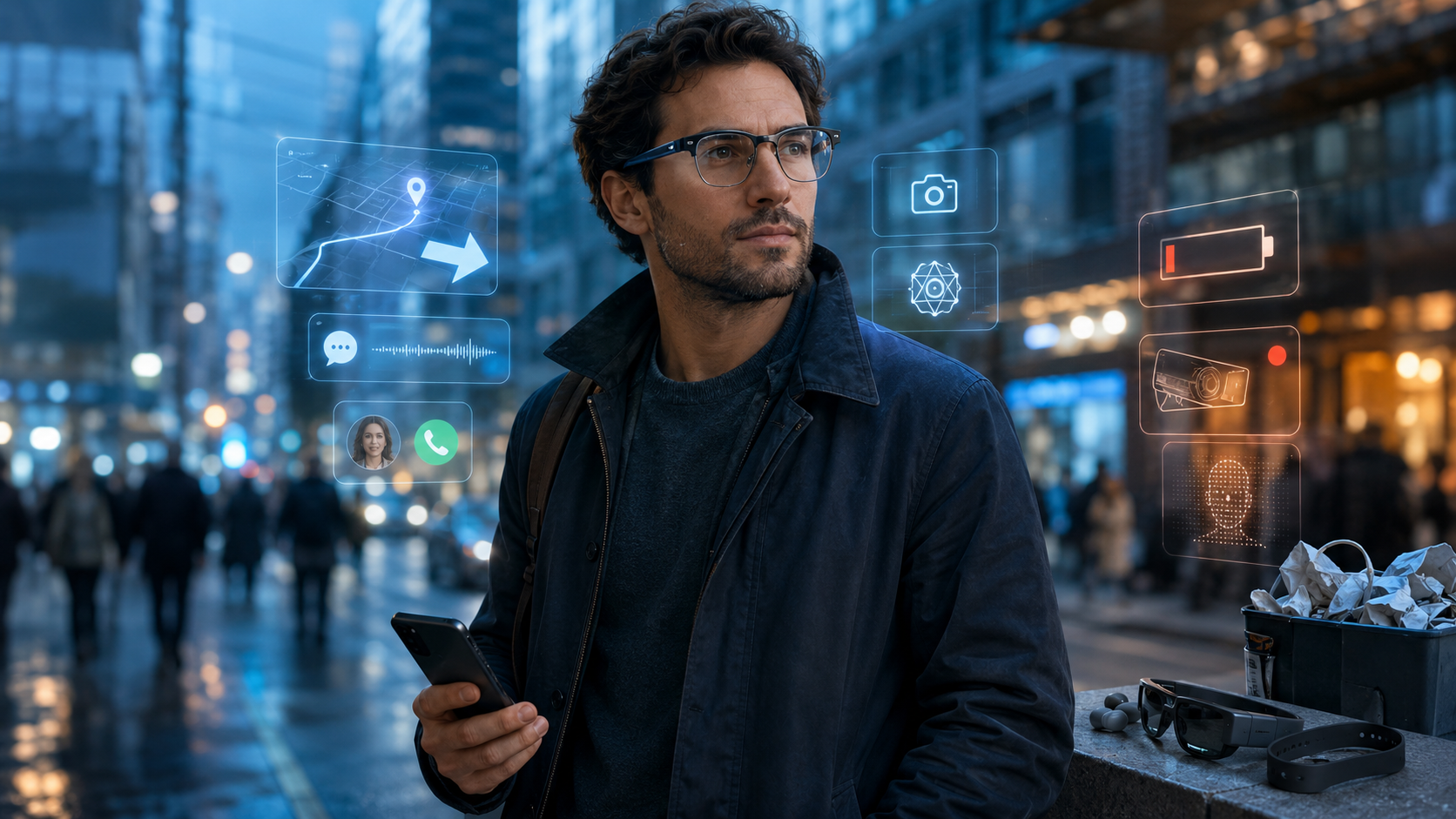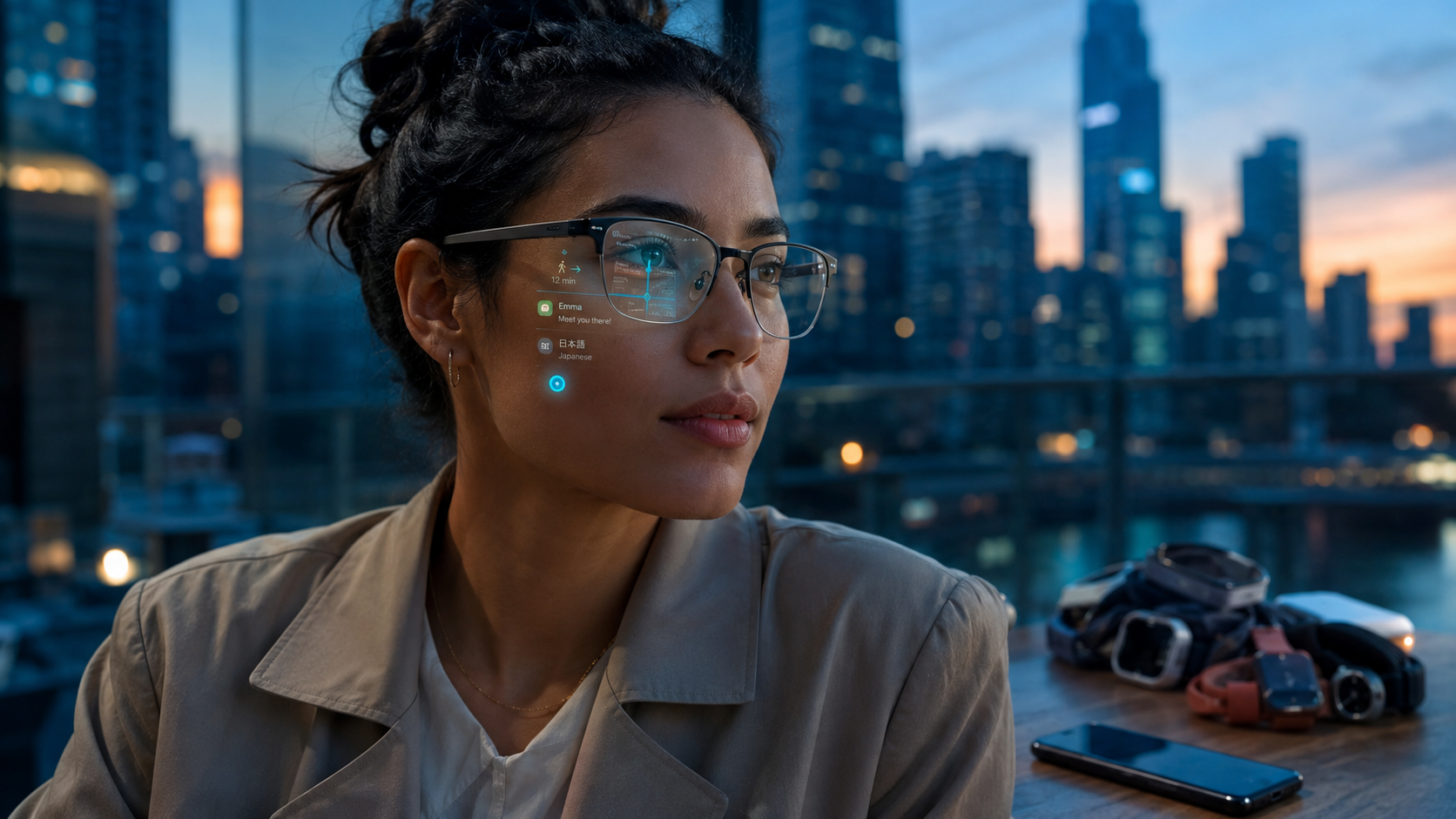
For more than a decade, technology companies have promised that smart glasses will eventually replace the smartphone. Instead of looking down at a rectangular screen, people would see directions, messages, translations and digital information directly in front of their eyes. A camera would capture important moments, an artificial-intelligence assistant would answer questions, and calls could be made without holding a device.
Until recently, this vision seemed more like science fiction than a realistic consumer product. Google Glass became a symbol of technological overconfidence, while Snap lost millions of dollars on unsold Spectacles. Bulky virtual-reality headsets attracted enthusiasts but failed to become everyday devices.
The situation is now changing. New smart glasses look more like conventional eyewear, AI assistants have become far more capable, and millions of consumers are buying products such as Ray-Ban Meta glasses. Google is preparing a new generation of AI eyewear, while Meta, Apple, Samsung and several Chinese manufacturers are investing heavily in wearable computing.
Does this mean smart glasses are finally ready to become the next smartphone? Or are consumers being offered another expensive gadget that will eventually end up unused in a drawer?
What Exactly Are Smart Glasses?
The term “smart glasses” covers several different types of products.
The simplest models do not have visual displays. They combine cameras, microphones, open-ear speakers and an AI assistant inside an ordinary-looking frame. Users can take photographs, record video, listen to music, make calls or ask questions through voice commands. Ray-Ban Meta glasses are the best-known example of this category.
A second category includes glasses with a small display that can show notifications, navigation instructions, live captions and translations. More advanced augmented-reality glasses can place digital objects and applications within the wearer’s view.
At the upper end are mixed-reality headsets such as Apple Vision Pro. These devices can create highly sophisticated digital environments, but their size and weight make them different from glasses designed for daily outdoor use. Apple’s current Vision Pro weighs between 750 and 800 grams, excluding its separate 353-gram battery. That is far too heavy to be treated like conventional eyewear, even though its technology offers a glimpse of what lightweight glasses might eventually provide.[1]
Smart glasses, therefore, are not a single product. They represent a developing range of wearable computers, from AI-powered camera glasses to fully immersive displays.
Why Earlier Smart Glasses Failed
Google Glass was introduced with enormous publicity in the early 2010s. It allowed users to view information, take photographs and interact with applications through a small screen mounted near one eye. However, its unusual appearance, limited battery life, high price and lack of essential applications prevented widespread adoption.
Privacy was another major problem. People did not always know whether a Glass wearer was recording them, leading to social hostility and even bans in some restaurants, cinemas and private establishments. Wearers were sometimes labelled “Glassholes,” demonstrating how quickly a technically impressive product can fail when it violates established social expectations.
Google eventually shifted Glass from consumers to industrial and professional customers. Even that chapter closed when the company stopped selling Glass Enterprise Edition in March 2023 and ended official support in September of that year.[2]
Snap experienced a different but equally instructive failure. Its first Spectacles were promoted as fashionable camera glasses that could record short videos for Snapchat. Initial excitement encouraged the company to order too much stock, but demand rapidly declined. Snap reported approximately $39.9 million in inventory-related charges in 2017.[3]
These failures revealed an important lesson: consumers will not wear technology on their faces simply because it is innovative. The product must be comfortable, socially acceptable, genuinely useful and attractive enough to be worn throughout the day.
Why Today’s Market Is Different
The new generation of smart glasses is succeeding where earlier products struggled: it begins with the appearance of normal eyewear.
Meta’s partnership with EssilorLuxottica, the company behind Ray-Ban and many other eyewear brands, has been particularly important. Consumers are not being asked to wear a miniature computer designed by an electronics engineer. They are buying recognisable Ray-Ban frames that happen to contain cameras, microphones, speakers and AI.
According to EssilorLuxottica’s 2025 results, more than seven million pairs of Ray-Ban and Oakley Meta smart glasses were sold during that year alone. Around two million Ray-Ban Meta units had been sold between their October 2023 launch and early 2025, meaning demand accelerated dramatically.[4]
Although these figures remain tiny compared with smartphones—the global smartphone industry shipped approximately 1.26 billion devices in 2025—they show that smart glasses have moved beyond the experimental stage.[5]
Market research company IDC estimates that approximately 13.6 million display-less smart glasses will ship globally in 2026, potentially rising to 27.3 million by 2030. IDC also expects average prices to decline as production expands and competition increases.[6]
These numbers do not prove that glasses will replace phones, but they show that the category is becoming commercially significant.
Artificial Intelligence Is the Missing Ingredient
Earlier smart glasses often felt like cameras searching for a purpose. Generative AI has given them a much clearer role.
Because glasses can see and hear what the wearer is experiencing, an AI assistant can respond to questions about the immediate environment. A traveller might look at a railway timetable and ask for the next departure. A tourist could request a translation of a restaurant menu. Someone cooking could ask how much longer a particular dish should remain in the oven. A user could identify a building, plant or product without typing a search query.
This combination of AI, camera and voice control is potentially more natural than operating a smartphone. The user does not have to stop, unlock a device, open an application and type. The glasses can provide information while the person continues walking, working or interacting with others.
Google is also returning to the market through Android XR and Gemini. The company has announced eyewear partnerships with brands including Warby Parker and Gentle Monster. Its planned glasses are intended to handle directions, messages, photographs and other tasks without requiring users to remove their phones from their pockets.[7]
Meta has moved further by introducing display-equipped Ray-Ban glasses controlled partly through a wrist-worn neural band. The glasses can present information within the wearer’s view while using subtle hand movements as an input method. Meta says the model offers up to six hours of mixed use, with additional power supplied by its charging case.[8]
AI has therefore transformed smart glasses from passive recording devices into context-aware personal assistants. Whether those assistants are accurate and dependable enough for everyday use remains a separate question.
The Strongest Argument: Convenience
The smartphone became dominant because it combined many devices—a telephone, camera, map, music player, computer and wallet—inside one portable object. Smart glasses could take the next step by making some of those functions instantly available.
Directions could appear without a driver or pedestrian repeatedly checking a phone. Live captions could help people with hearing loss follow conversations. Workers could receive instructions while keeping both hands free. Athletes could hear performance information without looking at a watch. Parents could photograph a child’s first steps while remaining present in the moment.
The technology could be especially valuable for people with disabilities. An AI camera may describe surroundings, read signs, identify objects or provide navigation assistance to someone with limited vision. The World Health Organization estimates that at least 2.2 billion people live with near or distance vision impairment, including at least one billion whose condition could have been prevented or remains unaddressed.[9]
However, accessibility features must be reliable. An inaccurate description, missed obstacle or incorrect instruction could create serious risks. Smart glasses should assist users, not encourage them to depend on an imperfect system.
Battery Life, Heat and Weight Remain Serious Problems
The central engineering challenge is easy to understand: manufacturers are trying to place a smartphone’s capabilities inside two narrow arms resting on a person’s ears.
Cameras, processors, batteries, wireless connections, microphones and displays all consume power and produce heat. Larger batteries increase weight, while smaller batteries require frequent charging. Bright displays are difficult to see outdoors and require additional energy. Prescription lenses add further complexity.
Current display-free models can generally operate for several hours, while charging cases extend their total usage time. Some sports-focused Meta glasses offer up to nine hours under specified conditions, but continuous recording, calling or heavy AI use can drain the battery more quickly.[10]
A smartphone can be placed in a pocket when it becomes warm or heavy. Glasses place that discomfort directly on the face. For mass adoption, manufacturers will have to achieve all-day battery life without creating thick, hot or unbalanced frames.
Privacy Could Decide the Future
The greatest obstacle may not be technical at all. It is the question facing everyone around the wearer: “Am I being recorded?”
A smartphone camera is generally visible when someone raises it to take a picture. Smart glasses can record from the wearer’s natural line of sight, making the action harder to notice. Meta has used an outward-facing LED to indicate when recording is taking place. The company described the indicator in its original Ray-Ban Stories as hard-wired so that nearby people would know when photographs or videos were being captured.[11]
Nevertheless, researchers argue that small lights do not fully solve the problem. A 2026 study involving 525 survey participants and 20 paired interviews found a significant difference between the protections wearers were willing to accept and those bystanders wanted. People being observed consistently demanded stronger notification and control.[12]
Oxford researchers have also warned that company privacy policies tend to focus on the wearer while neglecting the rights of people captured by the device.[13]
The danger becomes greater when smart glasses are combined with facial recognition. In 2024, two Harvard students demonstrated a system that used Meta glasses, facial-recognition tools and public databases to identify strangers and retrieve personal information in real time. The experiment showed that the required technologies already exist, even if they are not officially built into the glasses.[14]
Without clear laws and strong design safeguards, smart glasses could normalise a level of personal surveillance that many societies are not prepared to accept.
Will Apps and Services Be Good Enough?
Hardware alone did not make the smartphone revolutionary. Its success came from mobile internet access, application stores, maps, banking, social media, ride-hailing and millions of third-party services.
Smart glasses will require a similar ecosystem. Consumers need reasons to wear them after the novelty of hands-free photography disappears. Navigation, translation, communications, health monitoring, payments and workplace applications must work consistently across different countries and languages.
Developers also need common software platforms. Google hopes Android XR can play a role similar to Android on smartphones, while Meta is building its own hardware, AI and interaction system. Excessive fragmentation could slow growth if every manufacturer uses incompatible applications and controls.
There is also the accuracy problem. AI systems sometimes provide false or misleading information. An incorrect answer on a computer screen is inconvenient; an incorrect instruction delivered directly into a person’s ear while driving, travelling or working with machinery could be dangerous.
Smart Glasses Will Probably Complement the Phone First
The smartphone will not disappear soon. It provides a large private screen, an established keyboard, powerful cameras, secure biometric authentication and an enormous application ecosystem. It is also easier to share, repair and use for complex tasks.
Smart glasses are more likely to become a companion device in the way smartwatches did. People may use glasses for quick photographs, calls, navigation, translations and AI assistance while relying on the phone for writing, banking, shopping, video viewing and detailed work.
Over time, more computing may move from the phone to the glasses. The smartphone could become a pocket-based processing and connectivity unit while the glasses serve as the main interface. Eventually, advances in displays, batteries and on-device AI might allow glasses to operate independently.
That transition, however, will take years rather than months.
The Verdict: Neither a Replacement nor a Failure—Yet
Smart glasses are no longer merely another failed gadget. Millions of sales, major eyewear partnerships and rapid AI development show that they have found a genuine consumer market. Their ability to provide hands-free cameras, audio, translation and environmental assistance gives them practical value that Google Glass and early Spectacles lacked.
But calling them “the next smartphone” is premature. Today’s devices still face limited battery life, uncertain AI accuracy, incomplete software ecosystems and profound privacy concerns. Display-equipped models must also become lighter, cheaper and more attractive before ordinary consumers will wear them all day.
The most realistic outcome is gradual adoption. Smart glasses will first complement smartphones, then take over selected functions as the technology improves. Their ultimate success will depend not only on what the glasses can do for their owners, but also on whether everyone else feels comfortable living in a world filled with wearable cameras.
If companies solve the engineering challenges while respecting bystander privacy, smart glasses may become the most important personal-computing platform since the smartphone. If they ignore comfort, trust and social acceptance, they may simply become a better-designed version of the gadget that already failed once.
References
- Apple, Apple Vision Pro Technical Specifications.
- Google, Glass Enterprise Edition Announcement FAQ.
- U.S. Securities and Exchange Commission, Snap Inc. 2017 Annual Report.
- EssilorLuxottica, Full-Year 2025 Financial Results.
- Android Central, citing IDC, Global Smartphone Shipments in 2025.
- IDC, Augmented, Virtual Reality and Smart-Glasses Market Insights.
- Google, Intelligent Eyewear with Gemini.
- Meta, Introducing Meta Ray-Ban Display.
- World Health Organization, Blindness and Vision Impairment.
- Meta, Oakley Meta Vanguard Performance AI Glasses.
- Meta, Introducing Ray-Ban Stories.
- Wang et al., Mapping Wearer–Bystander Privacy Tensions.
- University of Oxford, Smart-Glasses Privacy Protections and Bystanders.
- The Verge, Students Used Meta Smart Glasses to Identify People in Real Time.