Economic analysis — July 2026
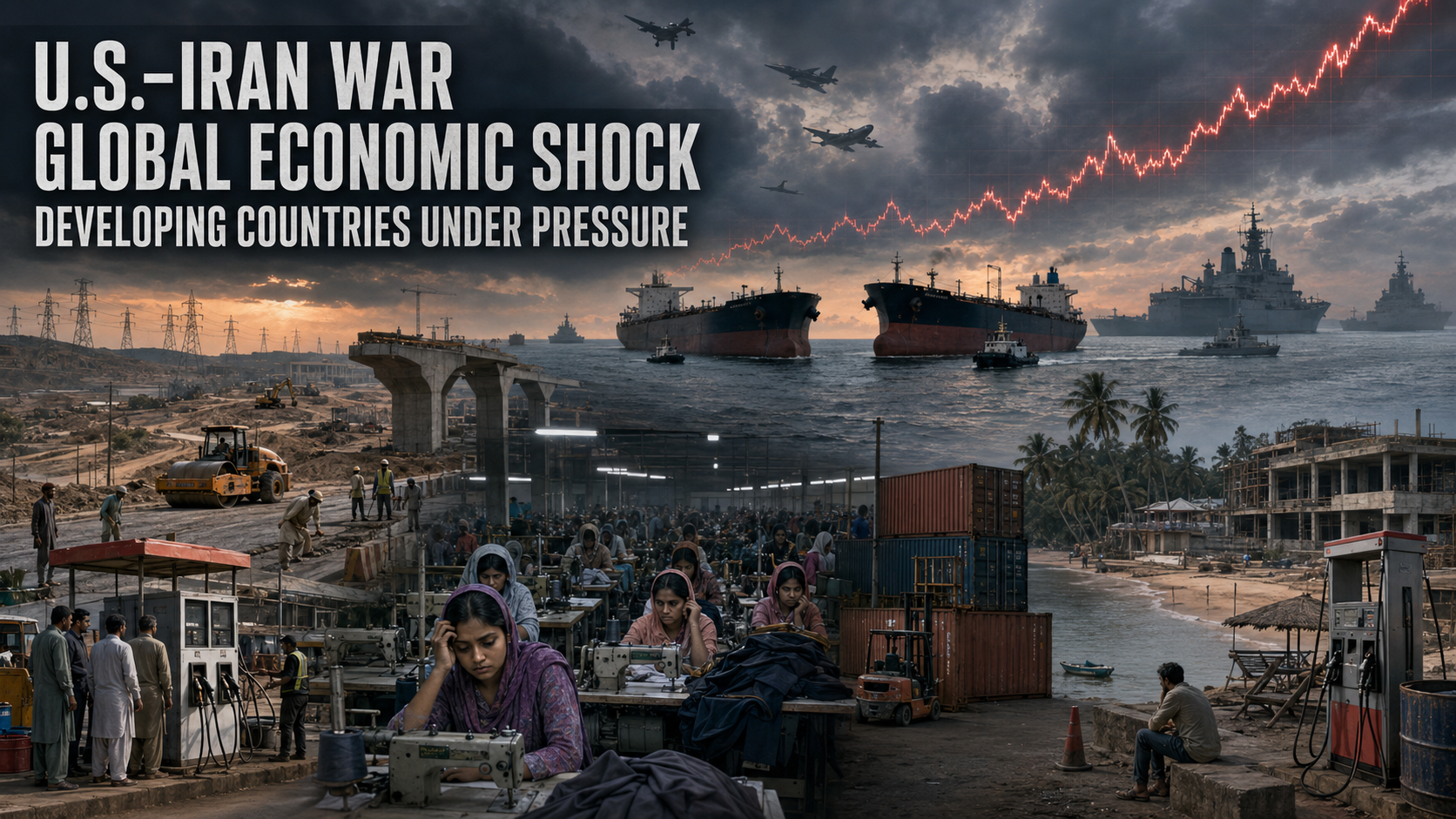
The war involving the United States and Iran has developed into a major global economic shock. Although the fighting is concentrated in the Middle East, its consequences have reached households, businesses and governments thousands of miles away. Disruption to petroleum and liquefied natural gas supplies, insecurity along international shipping routes, higher insurance costs and growing uncertainty have increased inflation and weakened the prospects for global growth.
The effects are especially serious for developing countries that depend on imported energy and possess limited foreign-exchange reserves. Pakistan, Bangladesh and Sri Lanka were already attempting to stabilize their economies, control public debt and finance ambitious development programmes. Higher fuel prices, expensive shipping and weaker investor confidence have now made those objectives considerably more difficult.
The crisis demonstrates how a military conflict in one strategically important region can disrupt development spending throughout the world.
The Strait of Hormuz: The war’s economic pressure point
The principal channel through which the conflict is affecting the global economy is energy. The Strait of Hormuz connects petroleum-producing states in the Persian Gulf with international markets. Oil, refined petroleum products and liquefied natural gas from Saudi Arabia, the United Arab Emirates, Qatar, Kuwait, Iraq and Iran normally pass through or near this narrow waterway.
The IMF described the de facto closure of the strait and damage to regional energy infrastructure as producing the largest disruption in the history of the international oil market. For fuel-importing countries, the Fund said, the increase in energy costs functions like a sudden tax on national income.
Even when some ships continue to operate, the risk of attack increases freight charges, security costs and marine-insurance premiums. Tankers may wait for safer conditions, travel at reduced frequency or demand a substantial risk premium. Consequently, importers can pay considerably more than the quoted international price of crude oil.
This is particularly damaging to Asian economies because they purchase large quantities of Middle Eastern petroleum and LNG. Alternative suppliers may exist, but supplies cannot always be redirected quickly. Ports, refineries and power plants are frequently designed for particular fuel specifications or long-term contractual arrangements.
- Slower growth and a renewed inflation problem
The IMF’s April 2026 World Economic Outlook projected global growth of 3.1 percent in 2026 and 3.2 percent in 2027 under the assumption that the conflict remained limited in duration and geographical scope. However, continued escalation has created the risk of a significantly worse outcome.
In July, the World Bank’s chief economist warned that a severe scenario involving hostilities lasting six months or longer could reduce global growth to approximately 1.3 percent in 2026 and push global inflation as high as 4.5 percent. These are scenario estimates rather than a certain forecast, but they illustrate the scale of the danger.
Higher petroleum prices affect inflation both directly and indirectly. Petrol, diesel, aviation fuel and cooking gas become more expensive immediately. The shock then spreads through transportation, electricity generation, agriculture, construction and manufacturing.
Businesses pass at least part of their additional costs to consumers. As a result, families pay more for food, transport, electricity, clothing and other essential goods—even when they do not own a vehicle.
The World Bank has forecast an overall increase of 16 percent in commodity prices during 2026, driven primarily by energy, fertilizer and selected metal prices. The rise in fertilizer costs is particularly dangerous because it threatens future food production as well as current inflation.
Central banks face an impossible-looking choice
Before the conflict, many central banks hoped to reduce interest rates as inflation moderated. The energy shock has complicated that plan.
If central banks maintain lower rates while fuel-driven inflation rises, national currencies may weaken and prices may increase further. If they raise interest rates, borrowing becomes more expensive for governments, businesses and households. Investment, construction and employment can then slow.
This creates the risk of stagflation—a combination of weak economic growth and persistent inflation. Advanced economies possess greater fiscal resources to protect consumers and support strategic industries. Poor countries have much less room to respond because many already carry substantial public debt and face high interest payments.
International trade, aviation and shipping
The Gulf and Red Sea are essential corridors for global trade. Insecurity around the Strait of Hormuz and Bab el-Mandeb has disrupted shipping schedules and raised the cost of transporting energy, food, fertilizer and manufactured goods.
Longer routes consume more fuel and delay the arrival of industrial inputs. Businesses must keep larger inventories or risk production stoppages. Small companies, which generally have less working capital, are particularly vulnerable.
Aviation has also been affected by airspace restrictions, route changes and expensive jet fuel. Airlines may cancel services, raise ticket prices or reduce capacity. This damages tourism and business travel, creating an additional problem for countries such as Sri Lanka that depend heavily on international visitors.
Financial markets, investment and developing-country debt
War encourages investors to move money into assets considered safer, including the US dollar, gold and highly rated government bonds. Capital can consequently flow out of developing countries.
A stronger dollar makes dollar-denominated petroleum imports and external debt payments more expensive in local currency. Governments then require more domestic revenue to service the same amount of foreign debt.
Private investors may also delay factories, infrastructure projects and acquisitions until the geopolitical situation becomes clearer. Rising global interest rates make it more expensive for developing countries to issue bonds or refinance existing obligations.
The result is a reduction in the financial resources available for roads, railways, schools, hospitals, water systems, energy projects and climate adaptation.
Why development programmes are among the first casualties
A fuel-price shock affects development budgets through several channels simultaneously.
First, governments must spend more on fuel, electricity and transportation. Second, they may provide energy subsidies or cash assistance to protect households. Third, inflation raises the construction costs of every infrastructure project. Fourth, slower economic growth weakens tax revenue. Finally, higher interest payments consume a larger share of the national budget.
A road, hospital or irrigation project approved at one estimated cost may become substantially more expensive when fuel, cement, steel and imported machinery rise in price. Governments must then increase the allocation, reduce the project’s scope or postpone its completion.
Although governments rarely announce that a particular school or road has been cancelled exclusively because of an international oil shock, this is how development plans become “jolted”: fiscal space narrows, procurement becomes more expensive, growth assumptions are revised and project implementation slows.
Pakistan: Economic stabilization faces a new external shock
Pakistan entered 2026 with improving but still fragile economic conditions. According to the Pakistan Economic Survey 2025–26, GDP growth for FY2026 was estimated at 3.7 percent. The country was working under an IMF-supported programme while pursuing fiscal consolidation, energy-sector reforms and increased development investment.
The war threatens that stabilization in several important ways.
Heavy dependence on Gulf energy
An IMF country report published in May 2026 stated that 81 percent of Pakistan’s fuel imports came from Gulf Cooperation Council countries. Pakistan therefore faces both higher international prices and additional regional premiums on refined petroleum products.
Any prolonged physical shortage would be even more damaging than higher prices alone. Electricity generation, transportation, industry and agriculture could all be affected if fuel supplies became unreliable.
The cost of petroleum is also reflected in Pakistan’s electricity tariffs because some power plants use imported fuels. Costlier power increases the price of manufacturing, particularly in energy-intensive sectors such as textiles, cement, steel, chemicals and engineering.
Pressure on foreign exchange and the rupee
A higher petroleum and LNG import bill creates additional demand for dollars. Pakistan’s foreign-exchange position has improved under economic stabilization, but a sustained energy shock could weaken the current account and put renewed pressure on the rupee.
Currency depreciation would amplify the shock by making petroleum, machinery, chemicals and other imported goods even more expensive in local currency.
Risks to agriculture
Pakistan is largely self-sufficient in urea production, but the IMF has warned that a prolonged disruption to supplies of diammonium phosphate, or DAP, could affect planting and agricultural productivity.
Diesel is required for tractors, harvesting, irrigation and crop transportation. Higher costs can reduce farmers’ profit margins and increase food prices. If farmers apply less fertilizer or use irrigation less frequently, future yields may also suffer.
Remittances are another point of vulnerability
Remittances amount to approximately 9 percent of Pakistan’s GDP, according to the IMF report, and about 55 percent originate in GCC economies. If Gulf construction, trade, aviation and services contract, employment opportunities for Pakistani workers could decline.
A fall in remittances would weaken household consumption and reduce one of Pakistan’s most important sources of balance-of-payments support.
Consequences for development plans
Pakistan’s federal and provincial development programmes depend on revenue collection and fiscal stability. Higher debt-service, electricity and fuel costs can crowd out allocations for dams, roads, schools, hospitals, housing and climate-resilient infrastructure.
Projects requiring imported machinery face additional exchange-rate and shipping costs. The government may therefore have to prioritize projects that are near completion while delaying new schemes. The longer the conflict continues, the greater the risk that economic stabilization will take precedence over development expansion.
Bangladesh: Energy shortages threaten industrial ambitions
Bangladesh’s economic model depends heavily on manufacturing exports, particularly ready-made garments. It also relies on imported petroleum and LNG to supply electricity, factories and transportation.
According to reporting based on government statements, Bangladesh was seeking more than $2 billion in additional external financing in March 2026 to manage its fuel and LNG crisis. The country was reported to import approximately 95 percent of its energy requirements and had introduced rationing in response to shortages and high prices.
Threat to the garment industry
The ready-made garment sector employs millions of workers and earns most of Bangladesh’s merchandise export revenue. Factories need reliable electricity and gas to operate machinery, dye fabric and meet delivery schedules.
Power cuts and expensive generator fuel raise production costs and reduce output. International buyers may transfer orders to competing countries if Bangladeshi manufacturers cannot guarantee price and delivery schedules.
Reduced garment exports would weaken foreign-exchange earnings precisely when Bangladesh needs more dollars to pay for expensive energy imports.
Fiscal pressure from energy subsidies
The government faces a difficult choice. Passing the full cost of imported energy to consumers risks raising inflation and provoking hardship. Absorbing the increase through subsidies places pressure on the national budget and state-owned energy companies.
Money used to finance energy losses cannot simultaneously fund transport infrastructure, healthcare, education, housing or climate adaptation.
Development and graduation ambitions
Bangladesh has invested heavily in power generation, roads, bridges, ports and industrial zones as part of its ambition to move towards higher-income status. However, construction materials and imported machinery become more expensive when shipping, petroleum and the dollar rise.
Inflation can also increase poverty and slow improvements in health and education. If employment in garments and smaller manufacturing businesses weakens, progress towards inclusive industrialization becomes more difficult.
Diversifying LNG and petroleum suppliers may improve security, but buying on spot markets during a global crisis can be expensive. Additional multilateral financing can provide temporary relief, yet it also creates future repayment obligations.
Sri Lanka: A fragile recovery confronted by another shock
Sri Lanka’s exposure is especially serious because it is recovering from the economic and sovereign-debt crisis that erupted in 2022. The country has been implementing reforms under an IMF Extended Fund Facility while rebuilding reserves, restructuring debt and restoring public confidence.
The IMF stated in May 2026 that the Middle East conflict had significantly worsened Sri Lanka’s outlook. Growth for 2026 was projected to slow to 3 percent, while higher petroleum prices were expected to raise inflation and weaken the current account.
Fuel imports and household costs
Sri Lanka imports most of its petroleum requirements. Higher international prices translate into more expensive transport, electricity generation and industrial production.
Under cost-reflective pricing reforms, global energy increases are more likely to be passed to consumers rather than hidden through large losses at state-owned enterprises. This helps prevent the re-emergence of unsustainable public liabilities, but it places immediate pressure on households.
The IMF programme provides for additional support through the Aswesuma social-protection system if high energy prices persist, subject to the government meeting its primary-surplus target. This illustrates the country’s narrow policy space: it must protect vulnerable families without abandoning fiscal discipline.
Tourism and remittances
Tourism is central to Sri Lanka’s foreign-exchange recovery. Airspace restrictions, expensive jet fuel, reduced flights and weaker global consumer confidence can lower visitor arrivals and tourism spending.
Employment disruption in Gulf countries could also affect Sri Lankan migrant workers and remittance inflows.
Development spending and debt sustainability
Sri Lanka needs investment in transportation, renewable energy, healthcare, education and climate resilience. However, the government must also maintain fiscal targets and restore debt sustainability.
Higher import costs and weaker growth reduce the resources available for development. The authorities cannot respond with unlimited subsidies or borrowing without risking a repeat of the imbalances that contributed to the earlier crisis.
Consequently, public investment must be carefully prioritized, with an emphasis on projects that generate exports, save energy or protect vulnerable groups.
What these countries should do
Pakistan, Bangladesh and Sri Lanka cannot determine the outcome of the war, but they can reduce its economic damage.
They should expand targeted cash assistance instead of introducing broad, permanent fuel subsidies. Universal subsidies are expensive and often provide the greatest benefits to wealthier households that consume more fuel.
Governments should also diversify energy suppliers, improve storage capacity and coordinate emergency purchases. Greater investment in solar, wind, hydropower and energy efficiency can reduce exposure to future petroleum shocks.
Public development programmes should prioritize projects that are close to completion, generate foreign exchange, improve public transport or reduce imported-energy consumption. Less urgent projects may need to be rescheduled transparently rather than being left unfinished.
International institutions should provide concessional finance, emergency trade facilities and temporary balance-of-payments support. Loans provided at expensive commercial rates would merely replace an energy crisis with a future debt problem.
Conclusion
The U.S.–Iran war has shown that energy security and economic development cannot be separated. The conflict has disrupted petroleum and LNG supplies, raised shipping costs, revived inflation and weakened global growth.
For Pakistan, the greatest risks are expensive Gulf energy, pressure on foreign exchange, reduced remittances and constrained development spending. Bangladesh faces fuel shortages, higher subsidies and disruption to its export-oriented garment industry. Sri Lanka must protect its still-fragile recovery while maintaining debt and fiscal reforms.
The war has not necessarily destroyed all their development plans, but it has made those plans more expensive, slower and more difficult to finance. Resources intended for infrastructure, education, healthcare and poverty reduction are increasingly being diverted towards energy imports, social protection and debt servicing.
A diplomatic resolution would provide the fastest economic relief. In the longer term, however, South Asian countries must reduce their dependence on imported petroleum, strengthen social-protection systems and build economies capable of surviving the next international energy shock.
References
- International Monetary Fund — World Economic Outlook, April 2026
- IMF — How the War in the Middle East Is Affecting Energy, Trade and Finance
- IMF — Global Economy Endures War Shock—So Far
- World Bank — Middle East War to Spark Biggest Energy-Price Surge in Decades
- World Bank — Oil Shocks, Remittances and Growth: The Data Behind South Asia
- Asian Development Bank — Macroeconomic Risks from the Middle East Conflict
- ADB — Prolonged Middle East Disruptions Could Choke Growth and Spur Inflation
- ADB — Asian Development Outlook, April 2026
- Government of Pakistan — Pakistan Economic Survey 2025–26
- IMF/Government of Pakistan — Third Review Under the Extended Fund Facility, May 2026
- IMF — Completion of Sri Lanka’s Fifth and Sixth Reviews Under the Extended Fund Facility
- IMF — Sri Lanka Review Press Conference, May 2026
- ADB — Economic Forecasts: Asian Development Outlook 2026
- Reuters — Bangladesh Seeks Financing to Address Fuel and LNG Crisis
- Reuters — Escalating Middle East War Could Sharply Reduce Global Growth