Muhammad Abdullah Hasan
South Asia occupies a central position in the global textile and clothing economy. Pakistan, India and Bangladesh collectively supply enormous quantities of cotton yarn, fabric, home textiles, ready-made garments and fashion products to markets in Europe, North America, the Middle East and Asia. Although the three countries share cultural traditions, skilled labour and long histories of textile production, their fashion industries have developed along noticeably different paths.
India has built the region’s largest and most diversified fashion ecosystem, supported by a huge domestic market, a broad manufacturing base and an internationally visible design community. Bangladesh has established itself as a global leader in large-scale ready-made garment production. Pakistan, meanwhile, combines a strong cotton and textile base with a rapidly expanding domestic fashion market, celebrated designers and significant potential in value-added apparel.
The future competitiveness of these three industries will depend not only on production costs but also on design, technology, sustainability, labour standards, branding and the ability to respond quickly to changing consumer preferences.
The Strategic Importance of South Asian Fashion
The fashion industry is much more than designer clothing and seasonal collections. It includes cotton cultivation, fibre production, spinning, weaving, dyeing, printing, garment manufacturing, embroidery, leather goods, footwear, retailing, e-commerce and fashion media.
Across South Asia, this extensive value chain provides employment to millions of people, including factory workers, craftspeople, farmers, retailers, designers and home-based workers. It also generates valuable foreign exchange for countries facing persistent trade and balance-of-payments pressures.
The International Labour Organization estimates that Asia and the Pacific employed about 65 million workers in garments, textiles and footwear in 2019. The region accounted for a large majority of workers in the global sector. However, the ILO has also highlighted widespread informal employment, temporary work arrangements, gender inequality and inadequate social protection throughout Asian garment supply chains.
These realities mean that competitiveness cannot be measured through exports alone. A successful modern fashion industry must create decent employment, use resources responsibly, protect workers and produce goods that can command better prices in international markets.
India: The Region’s Most Diverse Fashion Economy
India possesses the most complete fashion and textile ecosystem among the three countries. Its industry stretches from natural fibres such as cotton, silk, wool and jute to synthetic textiles, technical fabrics, ready-made garments, luxury fashion and mass-market retail.
The country’s enormous population provides it with a domestic consumer base that Pakistan and Bangladesh cannot match. Indian companies can build substantial businesses at home before entering international markets. The expansion of the middle class, urbanisation, changing lifestyles and growing internet access have strengthened demand for branded clothing, sportswear, beauty products, footwear and affordable fashion.
India also has a highly visible fashion culture. Mumbai, Delhi, Bengaluru and other major cities support fashion weeks, design institutes, luxury stores, film-related styling businesses and digital-first brands. Bollywood gives Indian clothing, jewellery and bridal fashion exceptional promotional power at home and within diaspora communities.
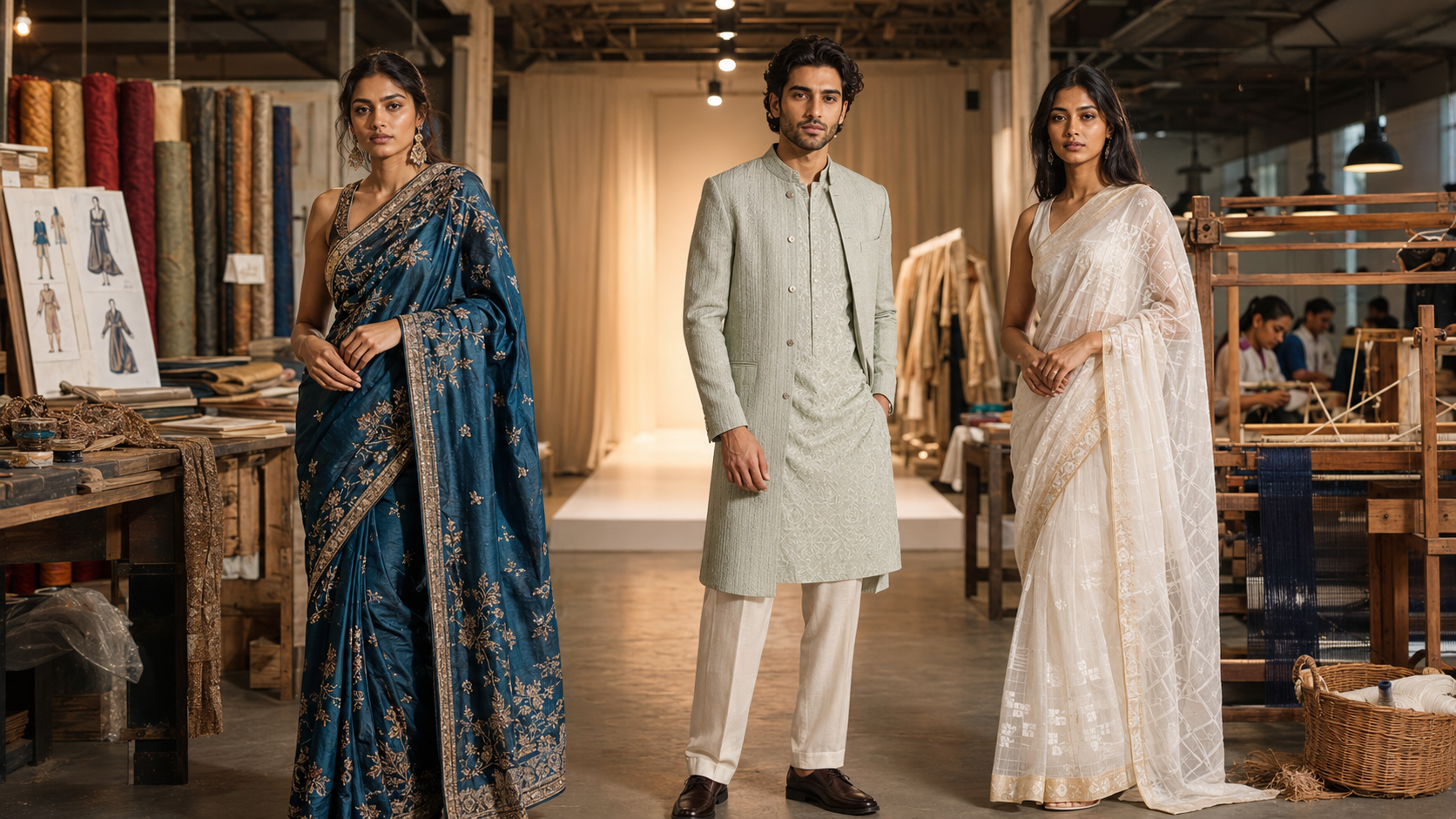
Another Indian advantage is product diversity. The country can produce inexpensive garments for mass retailers while also selling embroidered bridal wear, handloom textiles, silk sarees, artisan-made products and designer collections. Traditional techniques such as block printing, chikankari, bandhani, zari work and hand weaving offer Indian brands a cultural identity that cannot easily be reproduced by automated factories.
However, India’s size also creates complications. The industry is fragmented, with production divided among large exporters, small factories, artisans and home-based workers. Differences in infrastructure, compliance and productivity can make it difficult to achieve uniform quality and delivery schedules. High logistics costs and complex supply chains may weaken competitiveness against countries specialising in large-volume production.
India’s greatest opportunity lies in combining its design capacity, domestic market and manufacturing scale. If it improves factory efficiency, traceability, logistics and environmental performance, it can compete simultaneously in value fashion, premium clothing and sustainable artisan products.
Bangladesh: The Ready-Made Garment Export Champion
Bangladesh has developed the most export-focused apparel industry in South Asia. Its success is based on large-scale production, competitive labour costs, an experienced industrial workforce and strong relationships with international clothing retailers.
The country specialises primarily in the downstream part of the textile and clothing value chain: converting fabric and other inputs into finished garments for global buyers. According to the World Bank, Bangladesh became South Asia’s largest apparel exporter and built a significant share of the global clothing market. Ready-made garments have historically generated the overwhelming majority of the country’s merchandise export earnings.
Bangladesh is particularly competitive in basic, high-volume products such as T-shirts, trousers, sweaters, denim garments and casual wear. Manufacturers have learned to process very large orders while meeting strict delivery deadlines and the technical requirements of international brands.
The industry has also played a transformative social role. It brought millions of workers, particularly women, into paid employment and contributed to urbanisation, household income and poverty reduction. Nevertheless, employment quality, wages, workplace representation and worker safety remain crucial issues.
The 2013 Rana Plaza disaster, in which more than 1,100 people died, exposed severe weaknesses in factory safety and global sourcing practices. The tragedy led to unprecedented inspection, remediation and compliance programmes. Since then, many export-oriented factories have invested in structural safety, fire protection and greener buildings. Yet continuous monitoring remains essential, particularly among subcontractors and smaller production units.
Bangladesh faces another major challenge: overdependence on lower-value garments. Large export volumes do not always produce high profit margins because international buyers exert strong pressure on suppliers’ prices. The country must therefore expand into technical clothing, performance wear, lingerie, man-made fibres, fashion-sensitive products and its own brands.
Its future competitiveness will also be affected by the transition from United Nations least-developed-country status. As trade preferences change, manufacturers will need higher productivity, better trade agreements and more efficient logistics to protect market access.
Pakistan: A Strong Textile Base Seeking Greater Fashion Value
Pakistan’s main competitive strength is its integrated cotton-textile supply chain. It produces cotton and has extensive spinning, weaving, processing, garment and home-textile capacity. This gives manufacturers access to domestic raw materials and expertise across several stages of production.
Textiles remain the backbone of Pakistan’s export economy. According to the Pakistan Economic Survey 2025–26, textile products accounted for 59.6 percent of total exports during July–March FY2026. Textile exports stood at approximately $13.5 billion during that period, with knitwear, ready-made garments, bedwear, cotton cloth and towels among the leading categories.
Pakistan has achieved particular international recognition in home textiles, denim, knitwear and cotton products. Manufacturers in Karachi, Lahore and Faisalabad supply well-known global retailers, while Sialkot has developed specialised expertise in sportswear, gloves and performance-related products.
The country also has a lively domestic fashion industry. Pakistani bridal wear, lawn collections, formal clothing and modest fashion enjoy strong demand locally and among overseas Pakistanis. Designers have successfully combined traditional embroidery, regional crafts and contemporary cuts. Fashion weeks, television dramas, celebrity endorsements and social media have helped designers and retail labels reach a wider audience.
The lawn market is a distinctive example of Pakistan’s fashion-commercial connection. Seasonal printed-fabric collections have transformed an everyday textile into a highly marketed lifestyle product. Major brands compete through celebrity campaigns, exclusive prints and carefully timed launches.
Despite these strengths, Pakistan exports too many products in relatively low-value or buyer-controlled categories. International retailers often capture the largest portion of the final selling price through branding, distribution and marketing. Pakistani companies can improve their returns by developing original designs, creating exportable labels and moving from contract manufacturing to full-package fashion services.
Energy costs, inconsistent cotton production, outdated machinery in smaller units, expensive financing and policy uncertainty also limit competitiveness. Increasing the participation of women in formal manufacturing and management could expand the available talent pool. ILO findings indicate that, unlike several other major Asian garment-producing countries, men form the majority of the garment, textile and footwear workforce in both Pakistan and India.
Competitive Comparison of the Three Countries
India leads in overall diversity, domestic consumption, design visibility and the variety of fibres and fashion products it can produce. Its powerful media and entertainment industries provide additional support to designers and consumer brands.
Bangladesh leads in export-oriented ready-made garment manufacturing. Its factories are highly experienced in producing large orders for international retailers, particularly in basic apparel categories.
Pakistan’s advantages are cotton, yarn, fabric, home textiles, denim and a distinctive domestic fashion identity. However, it has not yet converted all these advantages into globally recognised consumer brands.
In simple terms, India is the most diversified fashion economy, Bangladesh is the strongest large-volume garment exporter, and Pakistan has one of the most promising integrated cotton-to-fashion value chains. Each country’s weakness is equally clear: India must overcome fragmentation, Bangladesh must reduce its dependence on low-margin basics, and Pakistan must increase value addition and improve reliability.
Traditional Craftsmanship as a Competitive Asset
All three countries possess valuable craft traditions. India has handloom weaving, silk production, mirror work, intricate embroidery and regional printing techniques. Pakistan is known for ajrak, block printing, phulkari, mirror work, hand embroidery and textiles inspired by Sindh, Punjab, Balochistan, Khyber Pakhtunkhwa and Kashmir. Bangladesh has jamdani, muslin traditions, nakshi kantha and other forms of hand craftsmanship.
These traditions should not be treated merely as cultural decoration. With proper geographical identification, artisan protection, quality assurance and international marketing, they can support premium fashion exports.
There is growing international interest in products that have a clear origin, human story and cultural identity. South Asian brands can benefit from this demand, but artisans must receive fair compensation and recognition. Otherwise, heritage techniques risk being commercially exploited without improving the lives of the communities that preserve them.
Sustainability and Labour Standards
Fashion production consumes large quantities of water, energy, dyes and chemicals. Textile processing can pollute rivers and damage surrounding communities when wastewater is not properly treated. Cotton farming also faces pressure from climate change, water shortages, pests and extreme heat.
Global buyers are increasingly demanding traceable raw materials, lower carbon emissions, recycled fibres, chemical management and transparent labour practices. Exporters unable to prove compliance may gradually lose access to premium markets.
Bangladesh has expanded green factory certification and safety reforms, while Indian and Pakistani producers are investing in renewable energy, water recycling and more efficient machinery. Nevertheless, improvements must spread beyond leading factories to small suppliers and subcontractors.
Labour standards are equally important. The ILO has documented high levels of informality in the Asian garment sector, including in Bangladesh, India and Pakistan. Temporary employment, limited social protection and gender pay gaps weaken the industry’s claim to sustainable development. Better wages, worker representation, safe transport, childcare facilities and opportunities for women to enter supervisory positions would create a more stable and productive workforce.
Technology, E-Commerce and the Future of Fashion
Digital technology is changing how clothing is designed, produced and sold. Three-dimensional sampling can reduce material waste and shorten product-development time. Automated cutting, inventory software and demand forecasting can improve factory efficiency. Digital traceability systems can help brands identify the origin of fibres, fabrics and finished products.
E-commerce is particularly important for Pakistan and India, where a young population and widespread smartphone use are helping fashion labels reach consumers without building expensive store networks. Bangladeshi manufacturers can also use digital channels to move beyond business-to-business production and develop direct relationships with international customers.
Technology alone, however, will not guarantee success. Companies must invest in workforce training so that automation improves productivity without simply displacing vulnerable workers.
The Road Ahead
The fashion industries of Pakistan, India and Bangladesh are competitors, but they can also complement one another. India has strong fibre diversity, design infrastructure and a huge consumer market. Bangladesh has exceptional garment-production scale. Pakistan offers cotton, textiles, denim, home furnishing expertise and a growing design culture.
Greater regional trade could allow fabric, yarn, machinery, design services and finished products to move more efficiently. Political tensions and trade restrictions currently limit that possibility. Improved cooperation could reduce costs and enable South Asia to compete more effectively with China, Vietnam, Türkiye and emerging African manufacturing centres.
Ultimately, the next stage of growth must be based on more than inexpensive labour. Bangladesh needs to move from volume to value. Pakistan must convert its textile capacity into branded fashion and higher-value exports. India must connect its fragmented production networks while protecting artisans and improving factory productivity.
If the three countries embrace innovation, sustainability, worker welfare and original design, South Asia can evolve from being primarily the world’s production centre into one of its most influential fashion regions.
References
- World Trade Organization — World Trade Statistical Review 2023
- World Trade Organization — World Trade Statistics
- Pakistan Economic Survey 2025–26 — Trade and Payments
- International Labour Organization — Employment, Wages and Productivity Trends in the Asian Garment Sector
- International Labour Organization — Gender Equality and Decent Work in Asia’s Garment Sector
- World Bank — Bangladesh Apparel Exports Can Create More Jobs
- World Bank — The Textile-Clothing Value Chain in India and Bangladesh
- World Bank — Bangladesh’s Textile Industry and Environmental Sustainability