India’s “Cockroach Movement” began as an irreverent response to a controversial courtroom remark, but within weeks it developed into a nationwide youth campaign demanding educational reform, employment opportunities and government accountability. Operating under the striking name “Cockroach Janta Party” (CJP), the movement combined street demonstrations with memes, parody videos, hunger strikes and viral social-media campaigns.
Its most significant victory came on July 25, 2026, when Indian Education Minister Dharmendra Pradhan resigned following sustained protests over alleged examination-paper leaks and other irregularities in the education system. The government subsequently accepted several demands made by the protesters, leading the CJP to suspend its nationwide agitation.
However, the Cockroach Janta Party remains better understood as a youth-led political movement than as a conventional electoral party. Whether it can transform its online popularity and protest success into a durable political force remains an open question.
The Controversial Remark That Started the Movement
The movement’s unusual name emerged from remarks attributed to Chief Justice of India Surya Kant during a Supreme Court hearing on May 15, 2026.
Early reports interpreted the remarks as comparing unemployed young Indians who turned towards activism, journalism, social media and Right to Information campaigns to “cockroaches” attacking the system. The comparison produced an angry reaction among students and young professionals, many of whom believed that unemployment and civic activism were being treated as personal or moral failures.
Chief Justice Surya Kant later said his observations had been misquoted. He explained that he had been referring specifically to people who entered professional fields using fake or bogus degrees—not to India’s unemployed youth generally. He reiterated that he respected young people and that the Supreme Court remained open to citizens seeking constitutional remedies.
The clarification, however, came after the “cockroach” label had already taken on a political life of its own. Instead of merely rejecting the description, young activists appropriated it. The cockroach—a creature associated with resilience, adaptability and survival—became a symbol of people who believed that India’s political and educational systems had attempted to ignore or silence them.
The controversy inspired political communications strategist Abhijeet Dipke to publish a sarcastic social-media response on May 16. His post went viral and led to the creation of the Cockroach Janta Party. What began as an online joke soon developed into an organised protest platform.
Abhijeet Dipke and the Emergence of CJP
Abhijeet Dipke, the founding figure of the movement, was reportedly born into a Dalit family in Maharashtra and was influenced by the writings and constitutional philosophy of B.R. Ambedkar. He studied political communication in the United States before returning to India to participate directly in the protests.
Dipke’s communication style was particularly attractive to younger Indians. Instead of employing the formal language normally associated with political parties, the CJP used humour, cultural references, short videos and self-deprecating jokes.
The movement deliberately avoided presenting Dipke as an unquestionable supreme leader. Following the minister’s resignation, Dipke warned supporters against turning him into a hero, arguing that excessive hero worship had damaged Indian politics.
CJP’s organisational material also described participants as volunteers rather than followers. Its protest guidelines stressed peaceful action, advising demonstrators to sit down if pushed, form human chains, avoid running and prevent provocateurs from creating violence.
This decentralised identity helped the organisation appear different from India’s established political parties.
Why the Movement Became So Popular
The courtroom controversy provided the name, but it was not the only reason for the movement’s rapid growth. The CJP connected with much deeper frustrations among Indian youth.
Repeated allegations of paper leaks in medical entrance examinations, recruitment tests and other competitive examinations had damaged public confidence in the education system. For millions of families, these tests represent a pathway towards professional education, stable employment and upward social mobility.
When a paper is leaked or an examination is cancelled, students may lose months or even years of preparation. Families can also lose substantial amounts of money spent on tuition, coaching, accommodation and travel.
The immediate crisis reportedly involved irregularities surrounding the 2026 medical entrance examination, affecting approximately two million candidates. Reports also linked the examination crisis and cancellations with the deaths by suicide of more than 20 students.
The protests therefore grew beyond a dispute over one examination. They became an expression of anger over:
- Repeated examination leaks and cancellations
- Youth unemployment
- Expensive private coaching
- Lack of good-quality employment
- Government accountability
- Economic inequality
- Police action against peaceful protesters
- The perceived failure of conventional political parties to represent young people
The movement’s message was simple: young Indians were not asking for charity; they were demanding fair access to education, employment and public institutions.
Memes, Instagram and the Social-Media Campaign
Social media was central to the Cockroach Movement’s growth. Instead of depending on established television channels, the CJP communicated directly with supporters through Instagram, X and short-form video platforms.
Its content included political memes, parody speeches, illustrations, sarcastic commentary and videos mocking government statements. The organisation turned the cockroach insult into a memorable brand. Reports suggested that its Instagram audience reached more than 20 million—and eventually approximately 25 million—followers within a remarkably short period.
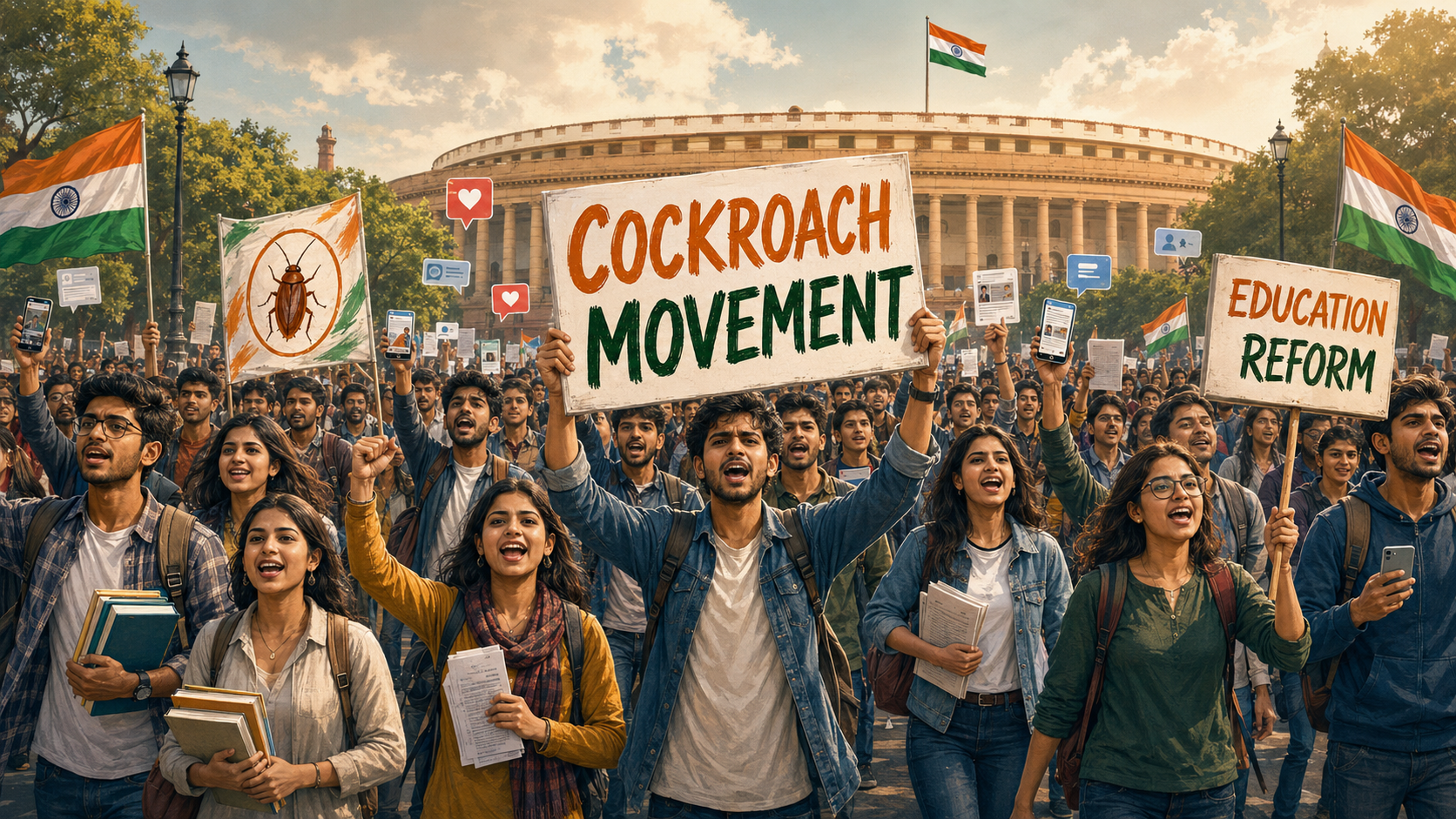
Campaign phrases such as “Cockroaches Are Coming,” “Chalo Dilli” and “Sansad Chalo” were used to mobilise supporters. At demonstrations, protesters carried posters demanding the protection of India’s Constitution and the resignation of the education minister.
Among the slogans heard or displayed during the campaign were:
- “Inquilab Zindabad” — Long live the revolution
- “Bharat Mata Ki Jai” — Victory to Mother India
- “Save Our Constitution”
- “Cockroaches Are Coming”
- “Chalo Dilli” — Let us go to Delhi
- “Sansad Chalo” — March to Parliament
- “Remember, do not mess with cockroaches”
The effectiveness of these slogans lay in their combination of humour and seriousness. Young protesters could joke about being cockroaches while simultaneously raising substantive questions about corruption, examination integrity and democratic accountability.
Social media also enabled practical forms of solidarity. People living far from Delhi used food-delivery applications to send meals to demonstrators at Jantar Mantar. At one point, organisers reportedly asked supporters to pause deliveries because the protest camp had received more food than it needed.
Participation of Young Men and Women
The movement attracted both young men and young women, including school students, university candidates, lawyers, professionals and first-time protesters.
Their participation was especially significant because many had never previously joined a political demonstration. Some young women described the movement as empowering because it allowed them to speak publicly about examinations, employment and their future.
A 16-year-old aspiring medical student, for example, told reporters after the minister’s resignation that the outcome made young people feel powerful and restored some hope in the future. Women also participated creatively: one protester reportedly arrived dressed as a bride, using performance and symbolism to draw attention to the way academic and employment uncertainty affected young people’s life choices.
The movement was not exclusively Gen Z. Parents, older activists, opposition politicians and civil-society figures joined the demonstrations. Nevertheless, its language, humour, visual identity and organisational methods were unmistakably youth-driven.
The participation of both boys and girls helped prevent the CJP from appearing to represent only one student group, region, caste or community. It presented itself as a wider generational movement.
Support—and Silence—from the Film Industry
Support from India’s film industry was visible but limited. Veteran actors Naseeruddin Shah and Shabana Azmi openly supported the movement, with Azmi reportedly appearing at a protest. Filmmaker Nandita Das, screenwriter Sutapa Sikdar and actors Bhumi Pednekar and Huma Qureshi were also named among entertainment-industry personalities expressing solidarity.
Actor couple Riteish Deshmukh and Genelia Deshmukh supported the youth-led “Sansad Chalo” campaign, saying that young voices deserved to be heard, supported and empowered.
However, the broader Bollywood response was characterised more by silence than collective support. Protesters criticised prominent film stars and cricketers who frequently commented on international matters but remained quiet about a domestic crisis affecting millions of Indian students.
Some observers argued that celebrities feared political, commercial or social-media retaliation. Therefore, it would be misleading to claim that the entire film industry supported the movement. A relatively small but notable group of actors and filmmakers spoke out, while many leading personalities remained publicly silent.
From Demonstrations to a National Confrontation
The CJP began organising public protests in Delhi and later expanded its campaign to Pune and other Indian cities. Demonstrations were reported in Mumbai, Kolkata, Chennai, Hyderabad and Bengaluru.
Jantar Mantar in New Delhi became the symbolic centre of the agitation. The campaign escalated through sit-ins, rallies and hunger strikes. Engineer and environmental activist Sonam Wangchuk joined the cause and undertook a hunger strike lasting 26 days.
On July 20, police used tear gas and batons to prevent demonstrators from marching towards Parliament. Images and videos of the police response circulated widely and attracted additional sympathy for the protesters.
What might otherwise have remained a student dispute became a national debate about the right to protest, the treatment of young people and the government’s willingness to accept ministerial responsibility.
Resignation of Education Minister Dharmendra Pradhan
The protesters’ principal political demand was the resignation of Education Minister Dharmendra Pradhan. The government initially resisted this demand, while promising action against officials responsible for examination irregularities.
The CJP argued that punishing lower-level officials was insufficient. It maintained that political leadership had to accept responsibility for repeated failures affecting millions of candidates.
On July 25, 2026, Pradhan announced that he had submitted his resignation to Prime Minister Narendra Modi. He said he respected the aspirations and legitimate expectations of India’s youth and did not want hostile forces to exploit the situation.
The resignation represented a rare instance of sustained public pressure forcing a senior minister in Modi’s government to leave office.
Following negotiations involving senior government representatives, the CJP said its outstanding demands had been accepted. These reportedly included:
- Wider reform of the national examination system
- Compensation for families of students who died by suicide
- Withdrawal of cases against peaceful protesters
- A commitment that no new cases would be registered against participants
- Stronger measures against examination-paper leaks
Prime Minister Modi subsequently announced a task force to overhaul the examination system and promised more transparent, technology-driven procedures, stronger penalties and new legislation against paper leaks.
After receiving these assurances, the movement called off its immediate agitation.
Is the Cockroach Janta Party a Real Political Party?
Despite its name, the CJP should not automatically be treated as a formally registered electoral party. It originated as satirical digital activism and then evolved into a protest movement.
Its future will depend on whether it chooses to remain a pressure group, develop into a civic organisation or register as a conventional political party and contest elections.
Remaining a movement would allow it to pressure different governments without becoming trapped in electoral calculations. Becoming a political party, however, would give supporters the opportunity to translate street mobilisation into legislative representation.
Each option carries risks.
Future Prospects of the Young Movement
The resignation of the education minister gave the CJP credibility, visibility and a powerful founding story. Few new movements achieve a major political concession so quickly.
Nevertheless, protest success does not guarantee electoral success. To become a durable political force, the CJP would need:
- A detailed programme extending beyond examination reform
- Transparent financing
- Democratic internal elections
- State and district-level organisation
- Policies on the economy, foreign affairs, agriculture and public health
- Protection against personality cults
- Mechanisms for verifying information before sharing it
- A strategy for converting social-media followers into committed organisers and voters
Its biggest strength is its ability to communicate with young Indians. Its biggest weakness is that online popularity can be temporary. Memes can mobilise people quickly, but governing a large and diverse country requires policy expertise, organisational discipline and compromise.
The CJP must also avoid misinformation. During the protests, Delhi Police rejected a viral claim that a female demonstrator had died during police action. Incidents of this kind demonstrate why a movement built through social media needs a credible fact-checking system.
If the organisation remains peaceful, democratic and focused on institutional reform, it could become an influential youth pressure group. If it contests elections, it may initially perform better in urban constituencies and university centres where examination and employment issues are particularly powerful.
Conclusion
India’s Cockroach Movement represents an extraordinary example of how an insult can be transformed into a political identity. Young Indians appropriated a demeaning label, converted it into a symbol of resilience and used humour, social media and peaceful protest to demand accountability.
Its campaign brought boys and girls, students, professionals, activists and some film personalities onto a shared platform. More importantly, it secured the resignation of a senior education minister and government commitments on examination reform and compensation.
The CJP’s first battle has ended in a dramatic victory, but its more difficult test lies ahead. It must decide whether it wants to remain a protest network or become a structured political party. If it can preserve its youth appeal while developing credible policies and democratic institutions, the “cockroach” may survive far beyond the protest camp—and become a lasting presence in Indian politics.
References
- Reuters — Abhijeet Dipke and the rise of India’s Gen Z protest movement
- Reuters — Education minister resigns after youth-led protests
- Reuters — Modi announces a panel to reform the examination system
- Associated Press — What to know about India’s Cockroach Movement
- Associated Press — Cockroach protests end after minister’s resignation
- Associated Press — Cockroach movement launches nationwide youth campaign
- Associated Press — Humour and memes power the Cockroach protests
- Associated Press — Nationwide supporters send food to protesters
- Associated Press — Police use tear gas to stop march towards Parliament
- The Guardian — Dharmendra Pradhan resigns following protests
- The Guardian — Celebrities criticised for silence over the protests
- Al Jazeera — Future of the movement after the minister’s resignation
- The Indian Express — Chief Justice clarifies the “cockroach” remarks
- Times of India — Film personalities support the “Sansad Chalo” protest