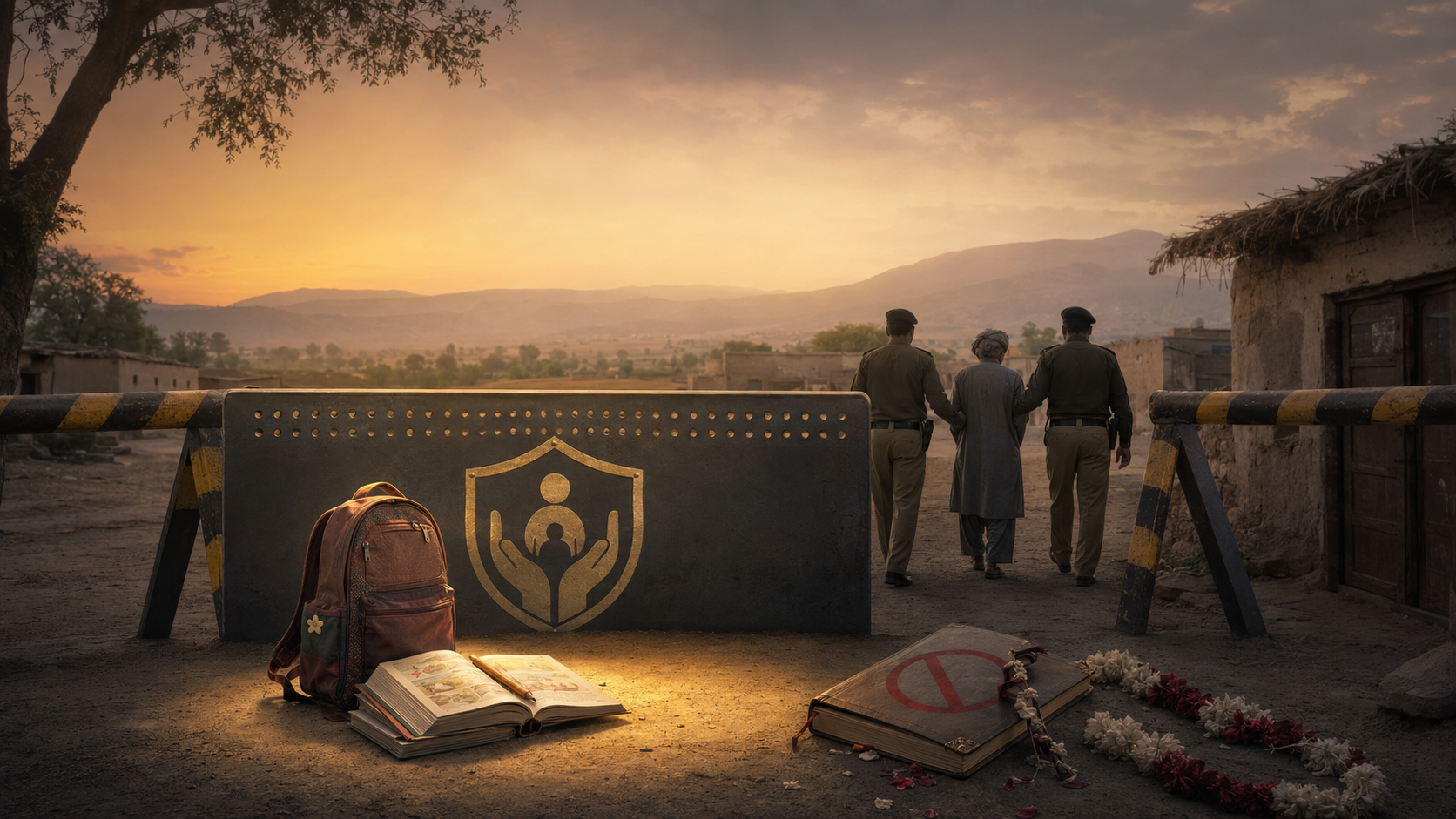
Shocking Dera Ghazi Khan case exposes the persistence of child marriage, poverty and weak enforcement despite tougher laws
An 80-year-old man has been arrested in Dera Ghazi Khan after allegedly purchasing and marrying an 11-year-old girl, in a case that has renewed concern over child marriage, the commercial exploitation of children and failures in Pakistan’s protection system.
The alleged marriage took place in Phagla, a remote tribal area of Dera Ghazi Khan district in Punjab. According to initial media reports, the girl’s father allegedly accepted Rs1.5 million from the elderly man in exchange for allowing him to marry his daughter.
Border Military Police Chief Commandant Ameer Taimur Khan reportedly took notice of the incident and ordered action against everyone involved. The elderly groom was subsequently arrested, while authorities began searching for the girl’s father and other alleged facilitators.
Officials also said action would be taken against the marriage registrar accused of solemnising or registering the marriage. The investigation had not concluded at the time of the initial report, and the allegations against those who had not been convicted should therefore be treated as unproven. 24NewsHD
More Than an Illegal Marriage
Although the incident has been widely described as a case of child marriage, its reported circumstances suggest a much wider range of possible offences.
An 11-year-old cannot provide free and informed consent to marriage with an adult. If investigators establish that money was paid to obtain control of the child, the case may also raise questions about the sale or trafficking of a minor, sexual exploitation, unlawful confinement, child abuse and the conduct of those who arranged or documented the marriage.
The alleged payment of Rs1.5 million is especially disturbing because it suggests that the girl may have been treated as property in a transaction between adult men. Poverty may help explain the circumstances in which such arrangements occur, but it cannot justify selling a child or exposing her to abuse.
Investigators will need to establish:
- Whether money was exchanged and who received it
- Who negotiated and arranged the alleged marriage
- Whether the child was taken to the elderly man’s home
- Whether she experienced physical or sexual abuse
- Whether her age was verified through official documents
- Whether false information was entered in the marriage record
- What role was played by the registrar, witnesses and community intermediaries
- Whether officials had previously received warnings about the planned marriage
The girl’s immediate safety is equally important. Arresting the groom is only the first step. Authorities must ensure that she is placed in a secure environment, receives medical and psychological support, and is not returned to a situation in which she could be subjected to retaliation or another forced marriage.
Her name, photograph, school, home address and other identifying information should remain confidential.
Punjab’s New Child-Marriage Law
The case occurred shortly after Punjab adopted significantly stronger legislation against child marriage.
The Punjab Child Marriage Restraint Act 2026 fixes the minimum marriage age at 18 for both girls and boys. The law replaced the previous distinction under which the minimum age had been 18 for males but 16 for females. Its official text is available through the Punjab Laws database.
The legislation prohibits marriage registrars from registering child marriages and provides penalties for adults who marry children, guardians who promote or fail to prevent such marriages, and people who solemnise or facilitate them.
It also treats offences as cognisable, non-bailable and non-compoundable. This means the alleged perpetrators cannot simply reach a private settlement with the child’s family to make the criminal case disappear.
The legislation further recognises the relationship between child marriage, abuse and trafficking. An earlier summary of the bill reported that cohabitation resulting from a child marriage could be treated as child abuse and that trafficking connected with marriage would attract severe punishment. The Punjab Assembly passed the bill on April 27, 2026, and it subsequently appeared in Punjab’s official laws as Act XXVII of 2026. Dawn
The Phagla case is therefore an important test of whether Punjab’s stronger law will be meaningfully enforced in remote communities.
Responsibility of the Marriage Registrar
The reported investigation of the marriage registrar is significant. Child marriages are rarely organised by only two people. They may require the participation of parents, witnesses, intermediaries, clerics or registrars.
A registrar should verify the ages and identities of the parties before completing a marriage record. Accepting verbal claims without examining reliable documents creates opportunities for the age of a child to be concealed.
Effective enforcement should therefore examine the entire chain of facilitation. Punishing only the groom while ignoring the adults who arranged and documented the marriage would leave the system that enabled the abuse largely intact.
Registration systems should also be connected with verified birth and identity records wherever possible. A digital age-verification mechanism could make it far more difficult to register an 11-year-old as an adult bride.
Similar Marriage Prevented in Larkana
The Dera Ghazi Khan incident was not an isolated warning.
In June 2026, police prevented the forced marriage of a 13-year-old girl to her 16-year-old cousin in Khero Dero village, Larkana. The intervention was carried out by the Women and Child Protection Cell with officials from the Women Police Station and Lashari Police Station.
Social activist Naween Mangi, who heads the Ali Hasan Mangi Memorial Trust in Upper Sindh, alerted police after attempts to stop the marriage through community intervention failed.
The prospective groom and members of his family reportedly fled when police arrived. The girl and her parents were taken to the women’s police station, where the parents were counselled about the law. Police obtained a written assurance that the girl would not be married before turning 18.
However, Mangi warned that the danger had not necessarily ended because the practice remained deeply embedded in the community. Her organisation continued monitoring the girl’s situation. Dawn
The Larkana case demonstrates the value of citizens, welfare organisations and specialised police units reporting planned child marriages before they take place. It also illustrates the limitations of relying solely on parental promises when the family itself may have arranged the marriage.
Pakistan’s “Monsoon Brides”
Economic distress has been associated with other reported cases of children being married in exchange for money.
In 2024, an AFP investigation documented underage marriages in the flood-affected village of Khan Mohammad Mallah in Sindh. Two sisters, aged 13 and 14, were reportedly married after their family suffered severe economic hardship. According to the investigation, 45 underage girls from the village had been married since the previous monsoon, including 15 during May and June 2024.
The cases became known as those of Pakistan’s “monsoon brides” because families struggling after destructive floods reportedly turned to early marriage as a financial survival strategy. Dawn/AFP
Climate disasters do not directly cause child marriage, but they can intensify the conditions that make girls vulnerable. Flooding can destroy crops, homes and livelihoods, force children out of school, displace families and increase household debt. In communities where girls are already viewed as an economic burden, such pressure can push families towards harmful decisions.
A National Child-Protection Crisis
UNICEF defines child marriage as a formal marriage or informal union involving a person under 18. It describes the practice as a violation of human rights that can interrupt education, cause social isolation, limit employment opportunities and increase exposure to domestic violence and early pregnancy.
Pakistan is home to more than 19 million child brides. According to figures cited in reporting based on UNICEF data, nearly one in six young Pakistani women was married before 18, while approximately 4.8 million were married before turning 15.
Available data also show strong links with poverty, location and education. Approximately 34 per cent of girls in Pakistan’s poorest households were married before 18, compared with about 7 per cent in the richest households. The prevalence was also higher among girls with no schooling than among those who had received secondary or higher education. UNICEF-supported Child Marriage Data Portal
These patterns show why criminal law alone cannot eliminate the practice.
Why Child Marriage Continues
Child marriage is sustained by several overlapping factors.
Poverty: Some families see marriage as a way to reduce household expenses, settle debts or receive money.
Lack of education: Girls who are not attending school are more vulnerable to early marriage. At the same time, marriage usually ends their opportunity to return to education.
Weak birth registration: When children lack reliable records, adults can misrepresent their ages.
Remote communities: Police, courts, schools and child-protection services may be inaccessible in rural and tribal areas.
Social pressure: Families may believe that early marriage protects honour or provides security, even though it often places girls at greater risk.
Poor enforcement: Laws have little effect when registrars fail to verify ages, officials ignore complaints or families can settle cases privately.
Economic and climate shocks: Floods, displacement, unemployment and debt can push already vulnerable households into desperate decisions.
UNICEF emphasises that child marriage results from a combination of poverty, social norms, concerns about family honour, inadequate legal structures and weaknesses in civil registration. UNICEF Data
Serious Consequences for Children
An 11-year-old is still developing physically, emotionally and psychologically. Marriage imposes adult responsibilities on a child who is not equipped to bear them.
Girls married in childhood face a greater likelihood of leaving school, becoming economically dependent and experiencing domestic violence. Pregnancy at a very young age can also carry severe health risks because the child’s body may not be sufficiently developed for pregnancy and childbirth.
The age gap in the Dera Ghazi Khan case makes the alleged power imbalance even more extreme. A child placed under the control of an 80-year-old adult would have little realistic ability to refuse demands, leave the relationship or obtain help.
Calling such an arrangement a “marriage” must not conceal the underlying issues of coercion and exploitation.
What Authorities Must Do Next
The investigation should be completed transparently and without pressure from local power structures. Authorities should pursue everyone who participated if the evidence supports prosecution, including the alleged buyer, the girl’s father, intermediaries, witnesses and registrar.
The government should also:
- Provide the child with long-term protection, counselling and educational support
- Conduct a medical examination only through trained professionals and with child-sensitive safeguards
- Verify whether other children in the area face similar risks
- Audit marriage registrars and take action against those ignoring age requirements
- Establish accessible reporting channels in tribal and rural communities
- Strengthen birth registration and digital age verification
- Expand girls’ education and financial assistance for vulnerable families
- Train police to treat forced child marriage as a protection and possible trafficking case
- Monitor rescued children instead of assuming that one police intervention ends the danger
A Test of Law and Society
The arrest of the elderly groom is an important intervention, but the final measure of justice will be whether the girl is permanently protected and all responsible adults are held accountable through a fair legal process.
Pakistan does not lack warnings about the consequences of child marriage. It now has stronger laws in several jurisdictions, growing public awareness and court decisions supporting the state’s authority to establish a minimum marriage age. In 2021, the Federal Shariat Court ruled that fixing a minimum age for marriage was not contrary to Islam and observed that such protection could help girls obtain an education. Dawn
What remains uncertain is whether those protections will consistently reach children living far from major cities.
The alleged sale of an 11-year-old to an 80-year-old man is not merely a troubling family decision or an unusual wedding. If proven, it represents the commercial exploitation of a child and a profound failure by the adults responsible for protecting her. The case must become a turning point—not another headline forgotten after the initial arrest.