I’m the mother of a fifteen-year-old girl named Lily, and if I had to describe her in one word, it would be tender. Lily has always felt the world deeply. She cries at sad commercials, rescues injured birds, and once emptied her entire birthday envelope so a classmate could buy a winter coat.
I used to worry that life would be too hard on a child like her—but I never imagined how quickly she would grow up. So when Lily told me she had a boyfriend, Evan, and that his family was kind, hardworking, and “going through a rough time,” I didn’t panic. I smiled, asked the polite parent questions, and told myself this was just another step in her growing up.
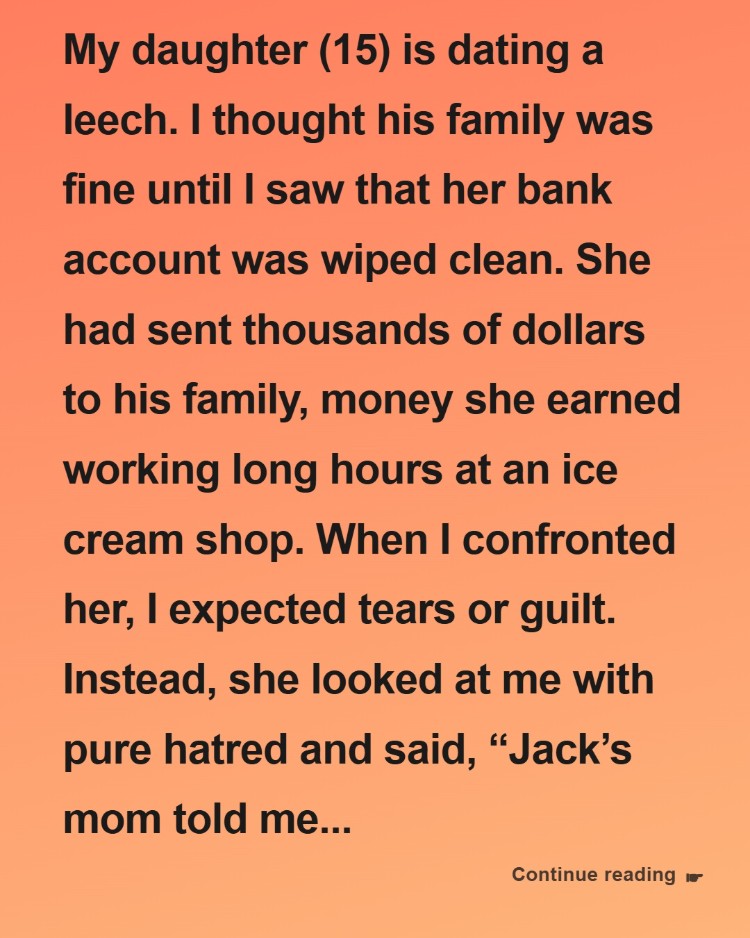
Everything felt normal—until one quiet Sunday morning when I logged into her bank account to transfer money for school fees. That was when my stomach dropped. Thousands of dollars were gone.
Not spent on clothes. Not on food. Transferred.
Repeatedly. All to the same unfamiliar name. At first, I thought there had to be some mistake. I refreshed the account, checked the dates, and stared at the transactions until the numbers began to blur. The payments stretched back for weeks. Some were small. Others were shockingly large. Together, they added up to an amount no fifteen-year-old should have been able to give away without her parent noticing.
I waited until Lily came home from work that evening.
I expected tears. I expected fear. I expected excuses.
What I didn’t expect was the look she gave me—hard, defensive, almost furious. “Evan’s little brother has leukemia,” she said before I could finish my sentence. “Their medical bills are insane.
And Evan’s been working two jobs since he was sixteen. What was I supposed to do? Watch him fall apart?”
I told her she was still a child.
That this wasn’t her responsibility. That she should have come to me. She laughed bitterly.
“Evan’s mom said parents who really love their kids support them when they want to help people in need. Guess that answers everything.”
That sentence hurt more than the missing money. It was the way she said it—not like a teenager defending her boyfriend, but like someone who had already decided I was the enemy. That night, I didn’t sleep.
I started noticing things I had ignored before. Lily’s constant exhaustion. The shadows under her eyes.
The way she barely ate before dragging herself to bed. When I checked her schedule, my heart sank. She wasn’t just working at the ice cream shop after school.
She had taken a second job waitressing on weekends. Quietly. Without telling me.
I found an old uniform folded beneath a stack of clothes in the back of her closet. There were receipts in one of her bags, handwritten notes about shifts, and a calendar filled with hours she had never mentioned to me. Suddenly, all those nights when she claimed she was tired from school made sense.
The next morning, shaking with anger and fear, I called Evan’s mother. I was ready to accuse her of manipulating my daughter. Ready to demand answers.
Ready to protect my child at all costs. But when she answered, she was crying. She told me they hadn’t known Lily was sending money at first.
When they found out, they begged her to stop. They returned what they could. They tried to set boundaries.
“But they keep finding ways,” she whispered. “My son thinks he has to be the man of the house. And your daughter… she believes love means sacrificing everything.
Neither of them sleeps. Neither of them knows how to stop.”
Her voice broke. “I don’t know how to protect them from their own hearts.”
For a moment, neither of us spoke. Then she admitted something that made my blood run cold.
“Lily came here once,” she said quietly. “She begged us not to tell you. She said you would stop her from helping Evan.”
I closed my eyes.
My daughter had been carrying a secret inside our home while I was completely unaware of how desperate things had become.
That night, Lily came home after another double shift.
She moved slowly, like someone much older than fifteen. Her shoulders sagged. Her smile was forced.
I watched her put her bag down and noticed how badly her hands were trembling. She tried to hide them by slipping them into the pockets of her hoodie, but I had already seen enough.
And suddenly, my anger disappeared. These weren’t reckless kids. They weren’t selfish.
They were two children trying to hold together a family that was breaking, believing love meant giving until nothing was left. And the frightening part was that neither of them seemed to understand how close they were to breaking themselves.
So I did the hardest thing I’ve ever done as a parent. I sat Lily down and didn’t yell.
I told her I was proud of her compassion—but terrified of what it was costing her. I told her love doesn’t mean self-destruction. That sacrifice without limits isn’t noble—it’s dangerous.
At first, she said nothing. Then she started crying.
Not the quiet tears I had seen so many times before, but deep, exhausted sobs that seemed to come from somewhere she had been hiding for months.
“I just wanted somebody to help them,” she whispered. “Everyone kept saying there was nothing they could do.”
I pulled her into my arms.
And for the first time, she admitted how much she had been hiding. She had convinced herself that if she worked harder, gave more, and asked for nothing in return, Evan would never have to choose between his family and the girl he loved.
Then I did what she never expected. I asked for help. I spoke with the school counselor.
I helped Evan’s family find legitimate medical aid programs and community support. I worked extra hours myself—not to replace what Lily had given, but to show her that adults carry adult burdens. And slowly, things changed.
Lily quit her second job. Evan started sleeping again. The money stopped—but the care didn’t.
There was one more difficult conversation, this time with both families together. We agreed that Lily would never again be responsible for medical bills, household expenses, or saving someone else’s family from financial disaster. Evan hated the idea at first, but eventually understood that accepting help did not make him weak.
A few weeks later, Lily showed me her bank account herself.
There was money in it again.
Not much, but enough.
She smiled when she showed me, and I realized that the number wasn’t what mattered. What mattered was that she no longer looked at her savings as something she had to surrender every time someone she loved was hurting.
Now, months later, Lily is still kind. Still sensitive. Still willing to help.
But she’s learning something just as important. Love should never ask a child to carry the weight of the world alone.
And sometimes, the bravest thing a person can do isn’t giving everything they have.
Sometimes, it’s finally admitting, “I need help, too.”