Norway’s King Harald V Dies Aged 89 After 35 Years on the Throne
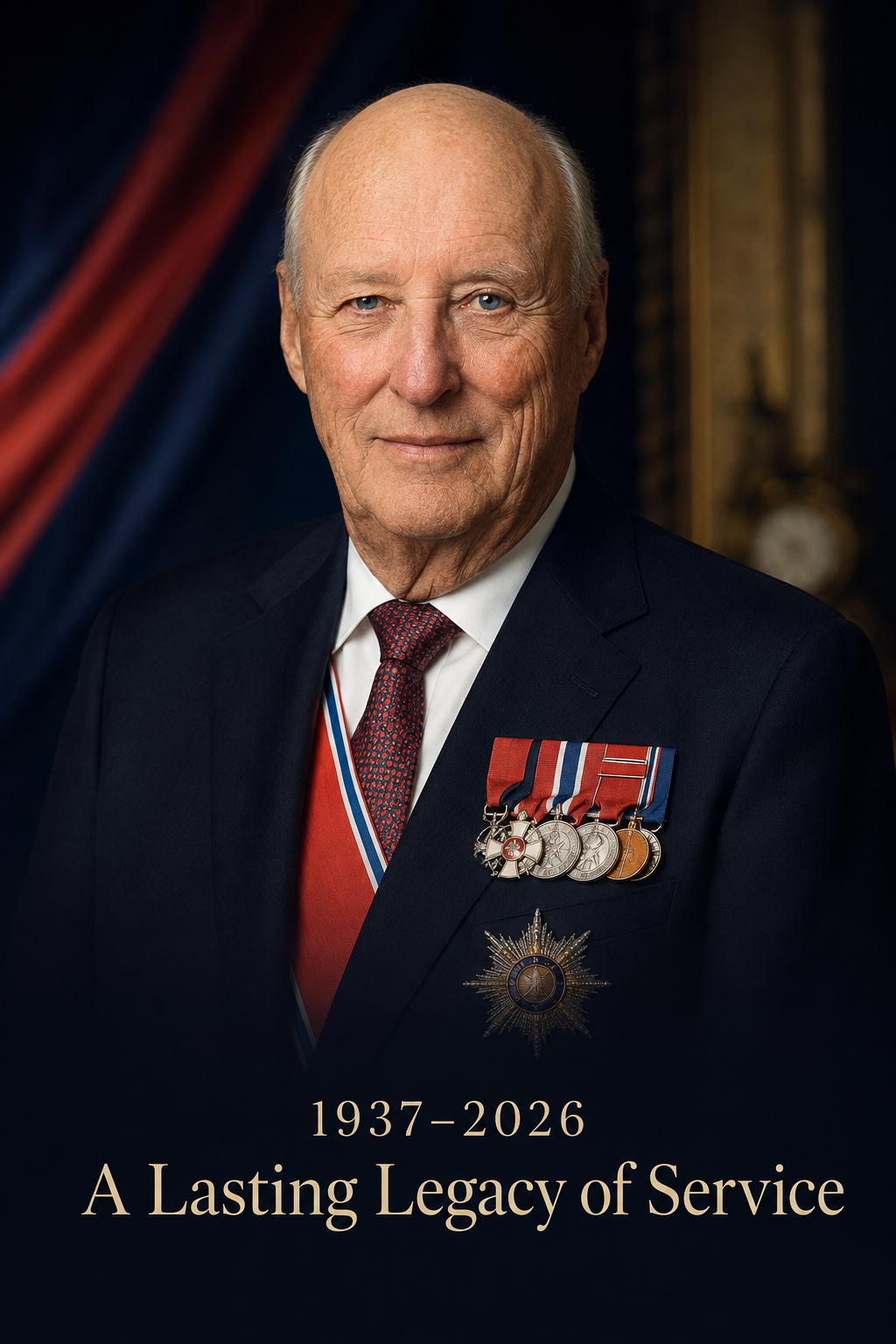
King Harald V of Norway, a widely respected monarch who helped modernize the royal family and guided his country through moments of celebration and national tragedy, has died at the age of 89.
The Norwegian Royal Palace announced that the King died peacefully at Oslo University Hospital Rikshospitalet at 6:35 a.m. on Friday, August 28, 2026. He had recently been receiving treatment after developing serious health complications. The Royal House of Norway
King Harald had reigned since January 17, 1991, succeeding his father, King Olav V. His death brings an end to a 35-year reign marked by social change, national prosperity and a gradual transformation of Norway’s monarchy into a more accessible and inclusive institution.
His son, Crown Prince Haakon, immediately succeeded him as Norway’s new monarch, King Haakon VIII.
A King Who Modernized the Monarchy
Although the Norwegian monarch’s position is largely ceremonial, King Harald became an important symbol of national identity, stability and unity.
Throughout his reign, he worked to make the monarchy appear less distant from ordinary Norwegians. He was known for his informal manner, gentle humor and willingness to address changes taking place in Norwegian society.
Harald was particularly admired for advocating tolerance and inclusion. In a celebrated 2016 speech, he described Norway as a nation that belonged to people from different backgrounds, religions and ways of life. His message included immigrants, refugees and members of the LGBTQ+ community, reinforcing his reputation as a progressive European monarch.
He also represented Norway during state visits, received foreign leaders and formally carried out constitutional duties, including opening sessions of parliament and presiding over meetings of the Council of State.
Born Into a Country Facing War
Harald was born on February 21, 1937, at the Skaugum estate near Oslo. He was the only son of Crown Prince Olav and Crown Princess Märtha and the first Norwegian prince born in the country for more than five centuries.
His early childhood was dramatically shaped by the Second World War. After Nazi Germany invaded Norway in April 1940, the three-year-old prince fled the country with his mother and two sisters.
They eventually found refuge in the United States, where Harald spent much of the war. His father and grandfather, King Haakon VII, remained with Norway’s government-in-exile in Britain.
The royal family returned to Norway following Germany’s defeat in 1945. Images of the young prince arriving home alongside his family became part of Norway’s collective memory of liberation.
Harald later attended the Norwegian Military Academy and studied history, economics and politics at Balliol College, Oxford.
A Royal Love Story That Challenged Tradition
Harald’s relationship with Sonja Haraldsen, the daughter of a clothing merchant, became one of the defining stories of his early life.
The couple reportedly dated privately for nine years because Harald’s father initially opposed the future king marrying a commoner. Harald eventually made it clear that he would not marry anyone else—an ultimatum carrying enormous consequences because he was the only male heir.
King Olav ultimately approved the marriage, and Harald and Sonja wed at Oslo Cathedral on August 29, 1968.
Their marriage helped change attitudes about royal tradition and paved the way for later European royals to marry outside aristocratic circles. The couple had two children: Princess Märtha Louise and Crown Prince Haakon.
Sonja became Queen of Norway when Harald succeeded his father in 1991.
An Accomplished Sailor and Olympian
Away from his royal responsibilities, Harald was an enthusiastic and highly accomplished sailor.
He represented Norway in sailing at three Olympic Games—in Tokyo in 1964, Mexico City in 1968 and Munich in 1972. At the Tokyo Olympics, he carried the Norwegian flag during the opening ceremony.
Harald continued competitive sailing well into later life and won medals in international events with his crew. His passion for the sea strengthened his connection with a country whose history and economy have long been closely tied to maritime life.
Guiding Norway Through Tragedy
One of the most significant tests of Harald’s reign came after the terrorist attacks of July 22, 2011, in which 77 people were killed in Oslo and on the island of Utøya.
The King’s emotional response helped comfort a shocked nation. Alongside Queen Sonja and other members of the royal family, he met survivors, grieving families and emergency personnel.
He spoke about the need to protect democracy, openness and compassion rather than allowing hatred to change Norwegian society. His leadership during the tragedy became one of the most remembered periods of his reign.
The King also addressed the country during other crises, including the COVID-19 pandemic and the deadly Gjerdrum landslide. His calm and empathetic public appearances reinforced his image as a reassuring national figure.
Years of Health Problems
King Harald experienced several serious health problems during the later years of his reign.
He underwent treatment for bladder cancer in 2003 and surgery for a heart condition in 2005. In 2020, he underwent another operation to replace a heart valve.
In early 2024, Harald became ill during a private trip to Malaysia and required a temporary pacemaker before being medically transported back to Norway. A permanent pacemaker was subsequently implanted.
His health continued to cause interruptions to his official schedule, with Crown Prince Haakon serving as regent on several occasions. Nevertheless, Harald rejected suggestions that he might follow other European monarchs by abdicating.
He repeatedly emphasized that the oath he had taken as king was for life.
Shortly before his death, the monarch was admitted to hospital after suffering from a serious blood condition and infection. The palace later confirmed that he had died peacefully with members of his family close to him. Reuters
King Haakon VIII Takes the Throne
Under Norway’s constitutional system, the succession took effect immediately following Harald’s death. His only son, Haakon, therefore became King Haakon VIII.
Born in 1973, Haakon had already performed many of his father’s duties during periods when Harald was unable to work. He now becomes Norway’s fourth monarch since the country gained full independence in 1905.
Norway does not conduct traditional coronations. The new king is expected to formally meet the government, take the constitutional oath before parliament and participate in ceremonies marking the beginning of his reign.
King Harald will be laid to rest in the royal mausoleum at Akershus Fortress in Oslo, where other members of Norway’s modern royal dynasty are buried.
A Lasting Legacy of Service
King Harald inherited a monarchy still strongly influenced by the wartime legacy and immense popularity of his father. Over more than three decades, however, he established his own identity as a compassionate, reform-minded and approachable head of state.
He witnessed Norway’s transformation into one of the world’s wealthiest and most socially progressive countries. At the same time, he sought to preserve the monarchy’s relevance by presenting it as an institution capable of embracing a changing society.
Harald’s devotion to public service was captured by the royal motto he inherited from his father and grandfather: “Alt for Norge”—“Everything for Norway.”
He is survived by Queen Sonja, Princess Märtha Louise, King Haakon VIII, his grandchildren and other members of the Norwegian royal family. His death marks the end of a significant chapter in modern Norwegian history and the beginning of a new era under his son.